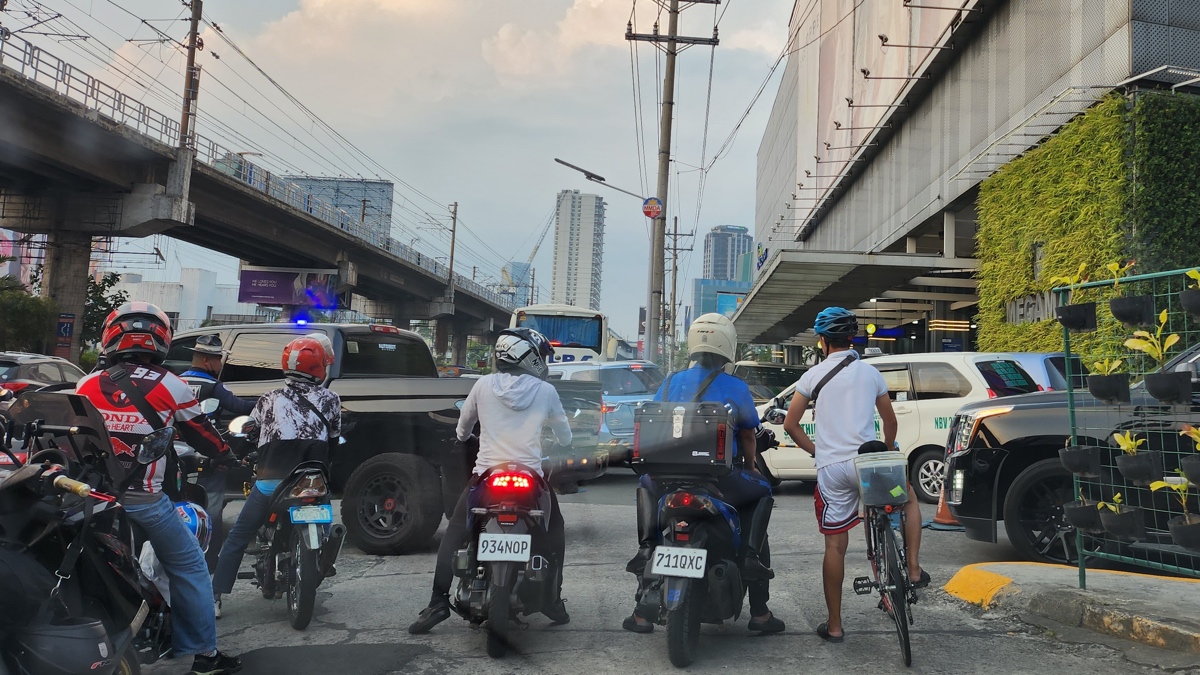
Let me start by saying that I’m a cyclist, and I am not a motorist’s enemy. I want to tear through Metro Manila with my bike as much as you want to enjoy your SUV. But the sad reality is that regardless of how we choose to get around the city—to drive, bike, or hail a jeepney—we all have to endure debilitating gridlock every single day.
If we reflect on a typical day, a good chunk of our decisions are dictated by the severity of road congestion, and the availability and quality of infrastructure. We can’t set meetings or meet people in random places; we are limited by the looming presence of traffic.
Sadly, we’ve had to live with these limitations for decades, compromising the very reason we are lured to cities: opportunities for business, better employment, and good education. Metro Manila has been restricting our freedom and quality of life, and robbing us of the joys of city living. But there is hope yet: A study done by Waze (Driver Satisfaction Index) in 2016 showed that the best place to bike is also the best place to drive.
Mobility, or the ability to go from one place to another, is a fundamental component of successful cities—especially megacities like Metro Manila. Part of this is our freedom to select a mode of transportation that meets our individual criteria for predictability, reliability, affordability, comfort, and safety.
Personally I chose biking as my mode of transport, but the preference and circumstance that led me to choose this as my main mode of commute is most likely different from yours. But before we can all optimally select, we need to be in an environment where all mode options are viable. Prevailing policies, infrastructure, and incentives, however, lead to an aspiration for private vehicles for city commutes. And right there's the rub. For in the same way that everyone is not expected to walk or bike, everyone must not be put in a position to have to drive.
Before 2022 came to a close, the Department of Transportation (DOTr) announced that pedestrians and bikers will get “top priority.” While this is a welcome development for active transport advocates, there also needs to be a comprehensive mobility plan from the national government—not just for Metro Manila but for all cities and municipalities across the country.
We need a plan that lays down a system where all modes of transport are put in the equation. The process will not be easy but it must be done. Policies and priorities will have to be rewritten, roads will have to be redesigned (yes, there is hope for Metro Manila). This is the vision: Elevating active and public transport as the superior form of transport will rationalize decisions and improve driving experience in cities.
It should never have been a competition between various modes of transport, but a masterfully orchestrated system where sidewalks lead to transit stops, jeeps and buses feed to mass rail alongside a well-protected and functional network of bike lanes, and there are equitably allocated lanes for motorized vehicles.
The good news is that we actually have the beginnings of this in Metro Manila. I can bike to a nearby mall to catch the P2P bus that departs every half hour to the South. The bus allows me to load my bike so that I can take it to complete my journey to work. What needs to be done now is for the government to take inspiration from this and expand it so that all cities can provide an efficient form of transportation for all.
In the meantime, as we anticipate government action, let’s collectively keep in mind that regardless of mode of transport, everyone’s journey is important. As we step out of our front doors and do our part in the workings of cities, let’s make our journeys as fulfilling as our destination. Take it easy on the accelerators and horns, say hello to the one less car on a bike outside your window, and let’s be the motorist/commuter/bicyclist we want to see on the road.