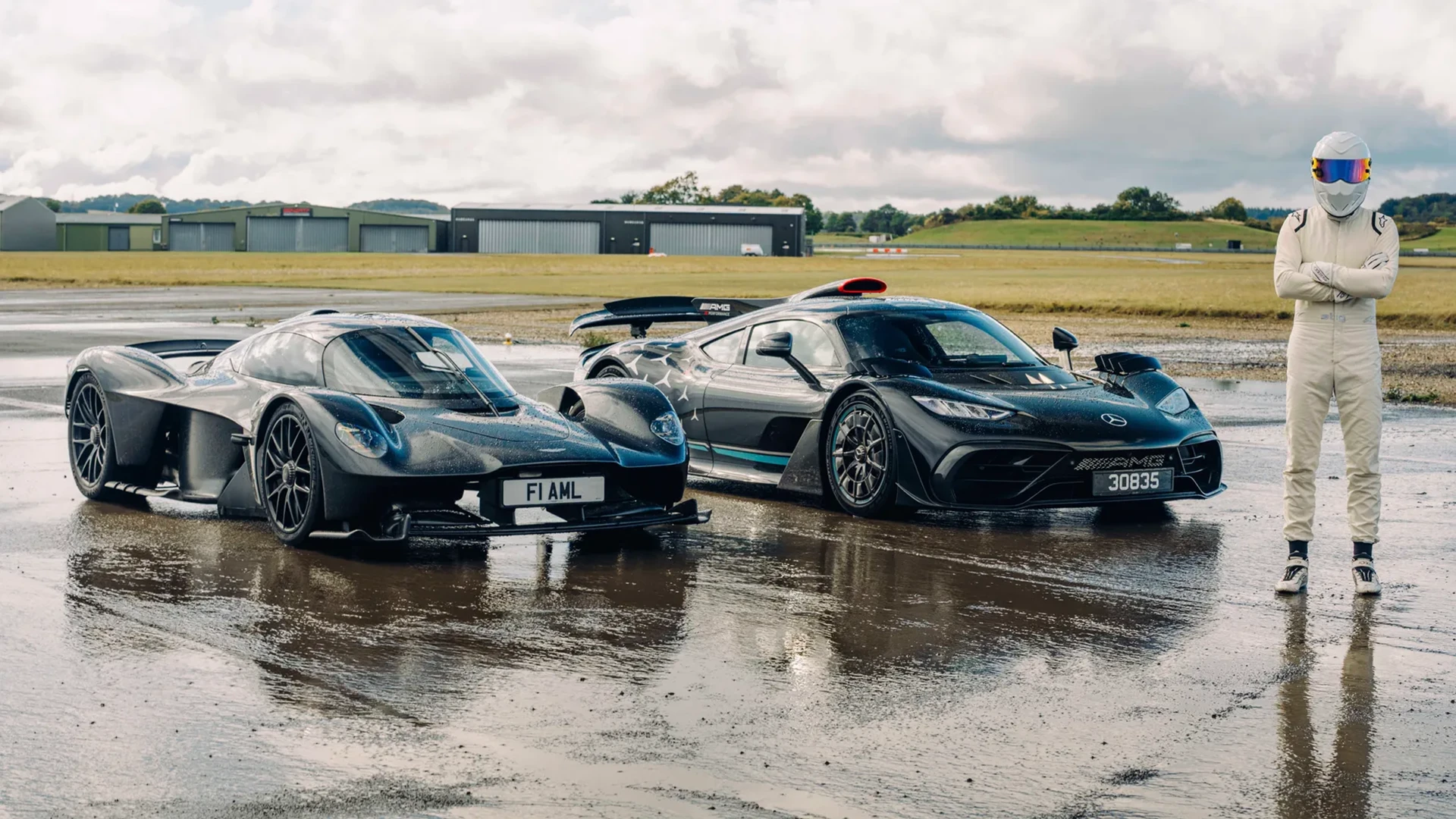
Ear defenders. Now we’re talking. Or perhaps not. Anyway, for the full ‘F1 team principal on the pitwall’ vibe, the Aston Martin Valkyrie comes equipped with a set of purposeful motorsport cans, complete with mouthpiece and trailing cables. For the full ‘no, it’s honestly fine in here’ vibe, the Mercedes-AMG One has a pair of surreptitious Sennheiser noise-cancelling in-ear buds. They’re engraved with the owner’s name. These two facts tell you a lot about each car.
That they’re terrifyingly noisy, mainly. And they genuinely are. You’ll have heard this about the Valk already, that while those outside enjoy pure red-blooded V12 symphony, those inside endure pure white noise V12 screech. But that the AMG One suffers similarly comes as a shock.
Did Merc not have enough time to sort that out? Six years it took for the One to make it into production, after it was first announced as the Project One in September 2017. Or is it that simply in keeping with the spirit of the car? We’ll find out.
ALSO READ:
Mercedes-AMG’s Concept AMG GT XX will feel and sound like a V8 super sedan
The Aston Martin Valhalla is here to take on the Ferrari F80 and the McLaren W1
Anyway, it endured roughly the same gestation as the Valkyrie, with that landing in owners’ collections in 2022, the AMG a year later. Technology developed, CEOs changed (the current Mercedes boss, Ola Källenius, joked “we were drunk when we said yes” to signing off on the One), but both firms stuck to their guns. Neither did a Jaguar XJ220, and promised one thing, only to deliver another.
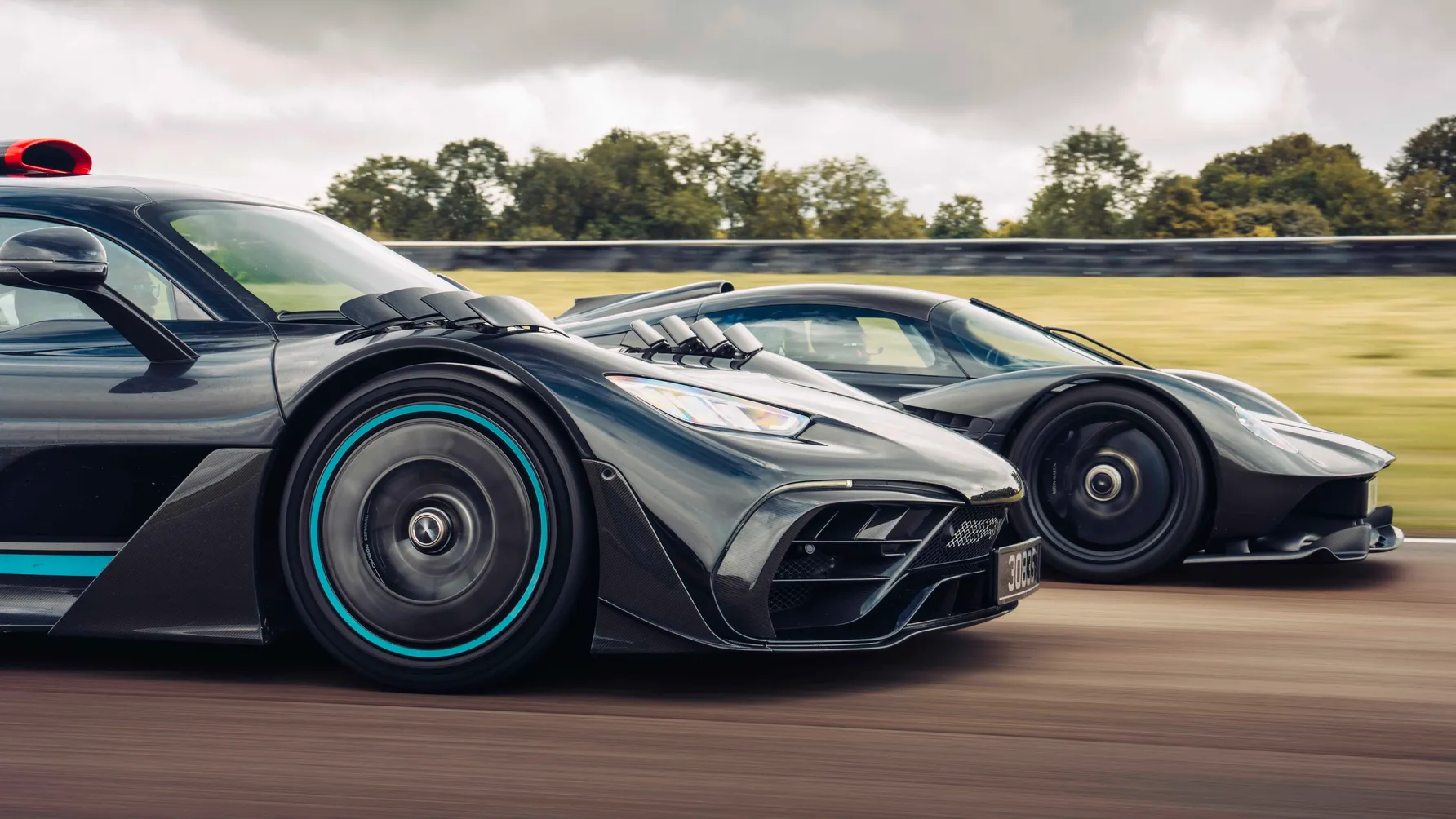
Genuine F1 technology in a road car. Quite how much actual F1 componentry made it direct from the 2016 W06 racecar to One road car, Mercedes isn’t saying, but the broad strokes of the powertrain are certainly the same—a 1.6-liter split turbo V6 with both MGU-H and MGU-K (motor generator units, heat and kinetic) systems, plus a couple of extra e-motors for the front wheels.
Direct F1 crossover is perhaps a more ethereal concept in the Valkyrie, but when the original brain behind it is arguably the most successful human in F1 history, you pay attention. Not least because the design he came up with is the most radical, singular road car there’s ever been. What’s not in doubt is that these two cars have direct F1 lineage that no other modern hypercar can match, not even Ferrari’s F80 or the GMA T.50.
But while that connects them, elevates them, let me tell you what the key separator is. Imagine it’s the initial stages of development and having briefed F1 colleagues at Brixworth (and presumably sent them into a flat spin), Mercedes has adopted its normal approach and is working out how to package those components alongside two beefy 95th percentile occupants. Those are the non-negotiable hard points, and the packaging is therefore dictated around them.
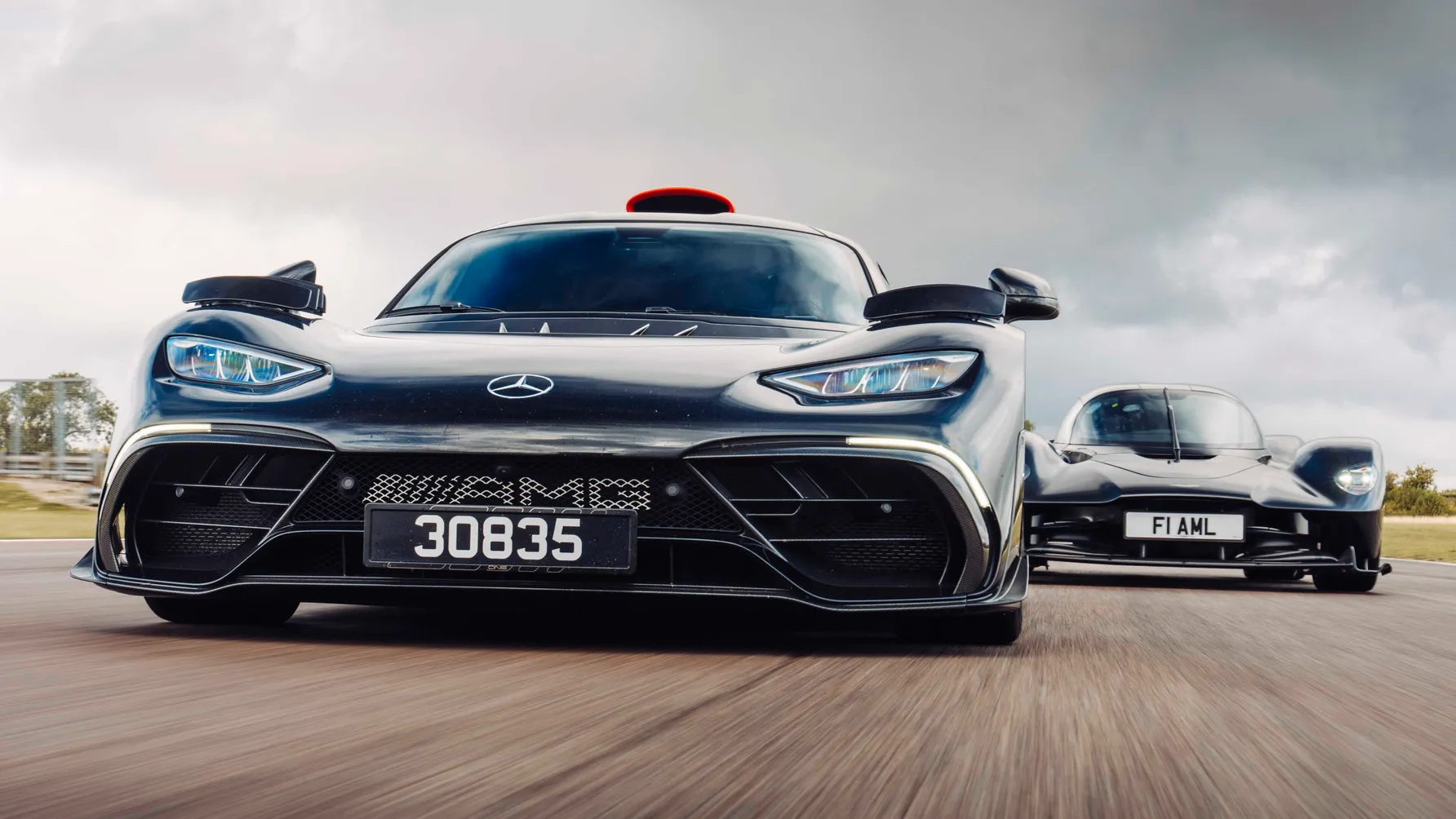
At roughly the same time, Adrian Newey is busily sorting the Valkyrie’s aero. That’s the only non-negotiable here, and once it’s done, he sees how much space he’s got left over for people. Realizing a pair of Smurfs will just about fit, he shrugs and moves on.
The lack of compromise, the single-mindedness of it, is what sets the Valkyrie apart. There’s never been anything like it. The McLaren F1 was Gordon Murray proving he could turn his hand to road cars; the Valkyrie is Adrian Newey taking the piss.
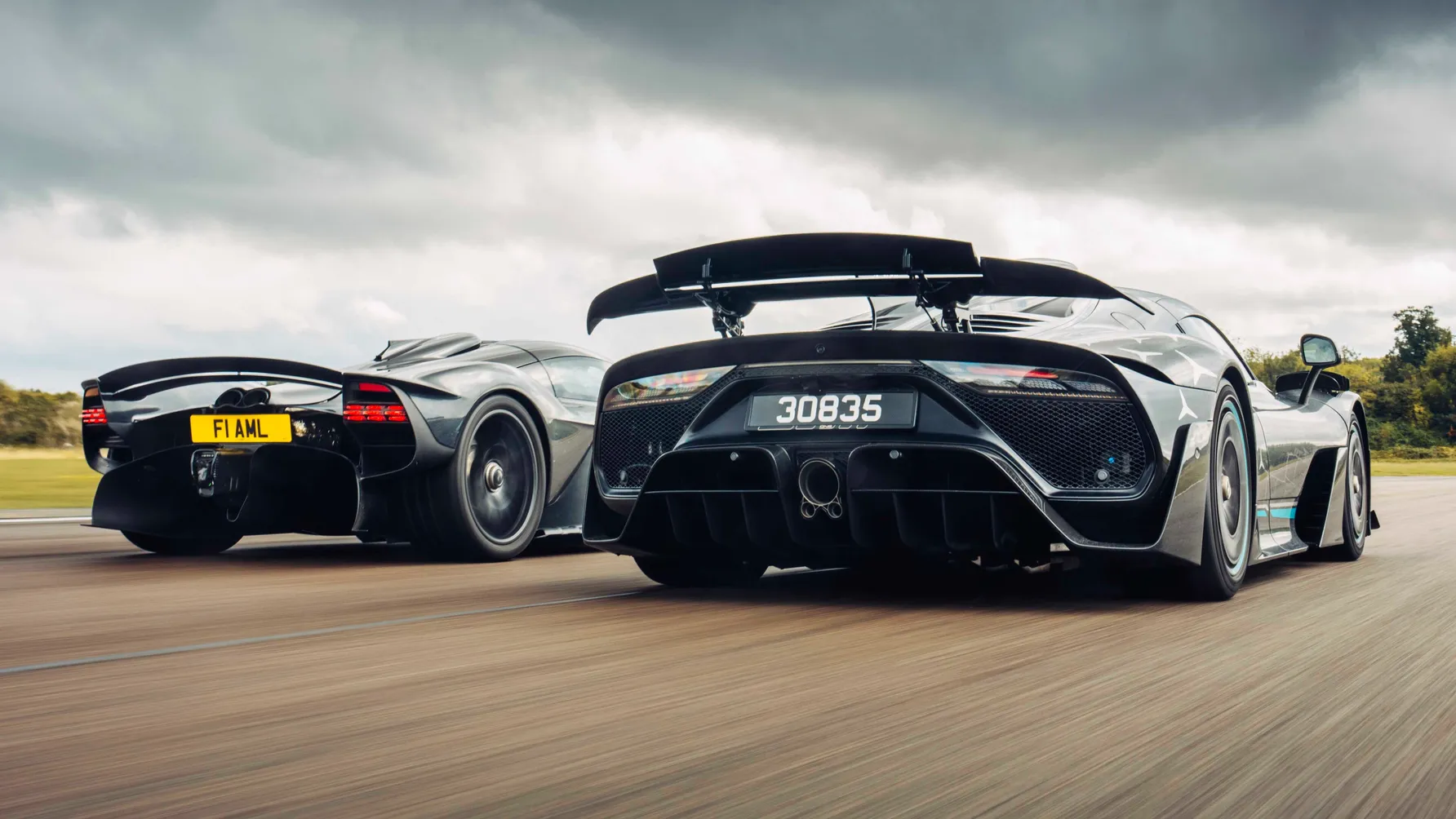
It is utterly radical. There is nothing else like it and probably never will be. Not even the RB17, as that won’t be road legal. It makes all other firms look like they’re leadfooted, set in their ways, scared to evolve and revolutionize. And above all, worried about alienating their customers. The AMG One is inevitably more conservative. It reminds me of a ’90s Group C car, broad, curved, well-covered. Striking, but if you took away the vertical fin, the shape wouldn’t be that remarkable.
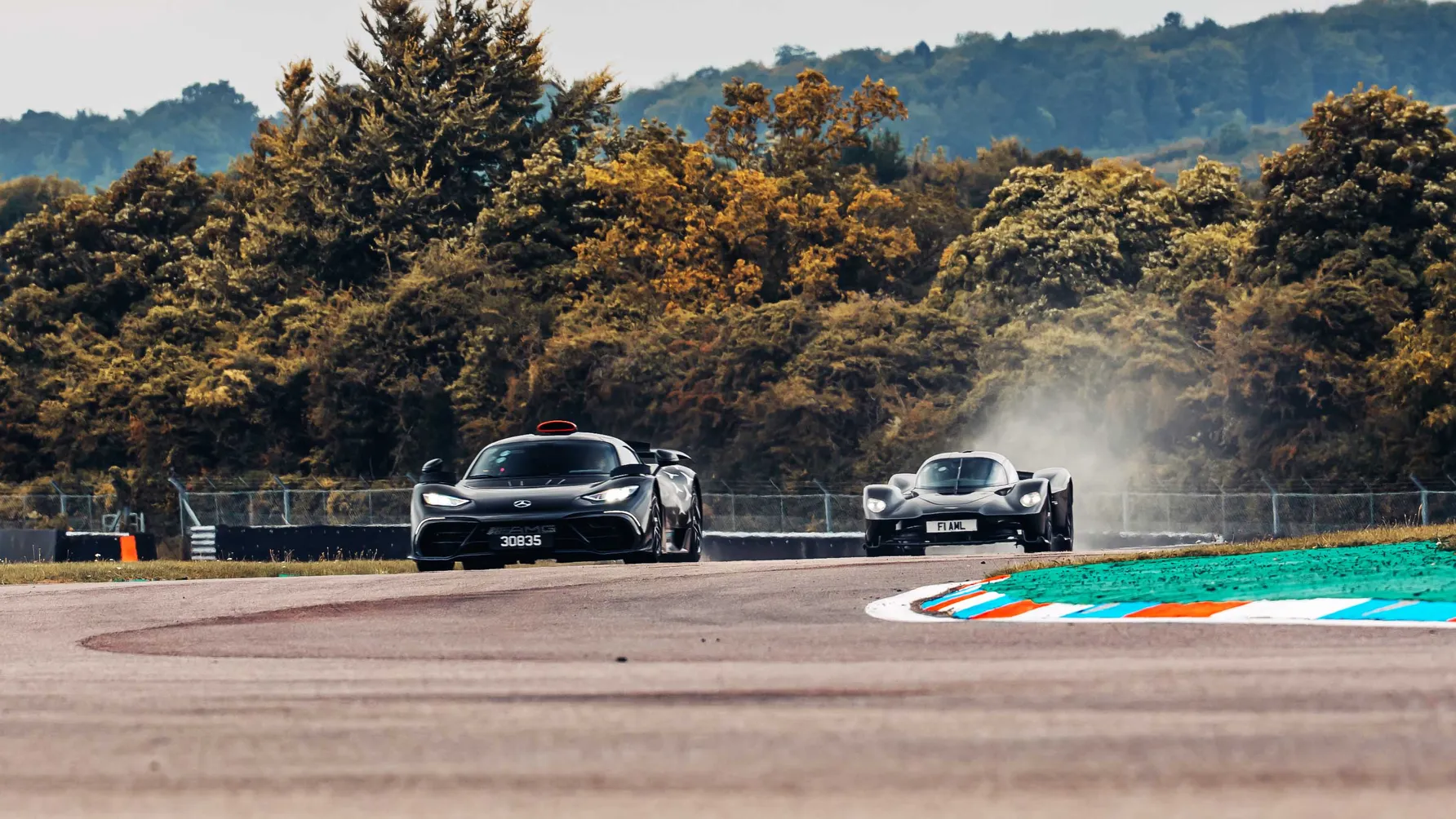
The Valkyrie is a preposterous-looking thing. From behind, it appears to hover, central tub dangling between outriggers, bodywork vacuum moulded over the top. It’s waspish, insectoid. But it can’t metamorphose. Get the button-pressing combo right, make sure fingers and small children are out of the way, and the AMG drops into Strat2 mode. Think flared lizard. Suspension drops, wings sprout, vents flick up. The full porcupine.
I mentioned above what separates them, but here’s what binds them—both have engines solidly mounted to their carbon tubs. Almost no one does this. In the past 30 years, I can only come up with one other car, Ferrari’s F50. Okay, if you’re into rare groove stuff, the Caparo T1. BAC Mono if we’re counting lightweights.
Why? Because the engine vibrations are transmitted directly into the chassis, the carbon acts like a speaker amplifying them, and you end up having to wear ear defenders. The advantages are rigidity and lightweight. No need for the rear subframe to be so heavy (or even exist at all in the case of the Valk) when the suspension can be directly mounted to the drivetrain.
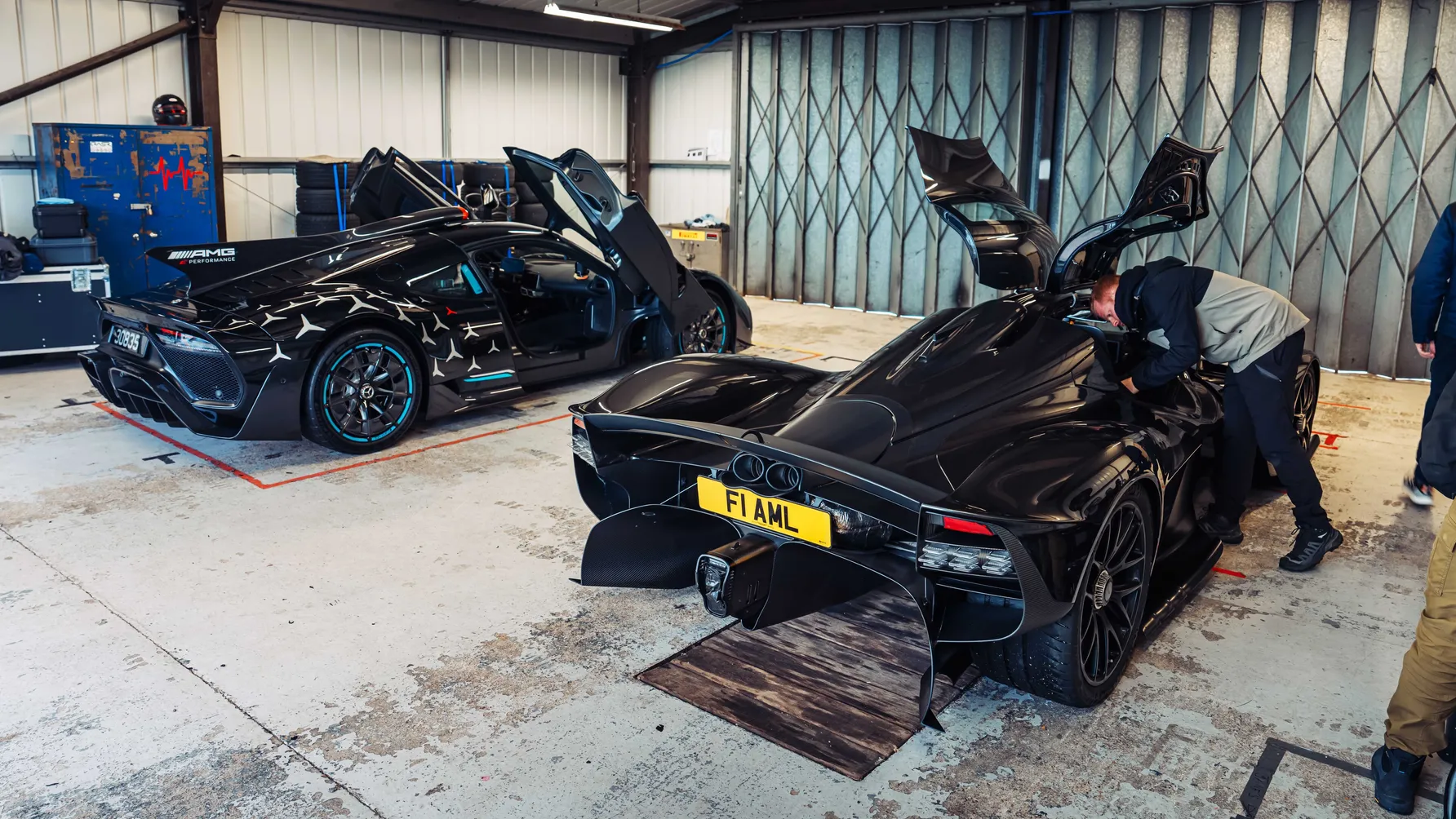
I know it sounds like a geek point, but this is telling. That Mercedes, knowing the unavoidable drawbacks and constraints, persisted with a rigid-mounted engine says as much about this car and its approach as the powertrain. My fear was that Merc would be unable to resist its own ethos, that putting an F1 engine in a hypercar would be fine, provided the rest of the package obeys the three-pointed star’s brand values.
Instead, we have something that looks kind of calm and sensible but behaves way more viscerally, something genuinely compromised. That sensation starts early. It’s almost as tricky to get into as the Valkyrie. That’s like going potholing; this is like reversing yourself into a toilet cubicle. You have to go in ass first. Try foot first, and the awkward door angle demands limbo skills. So instead, you drop your backside and swing your legs around. You’re in.
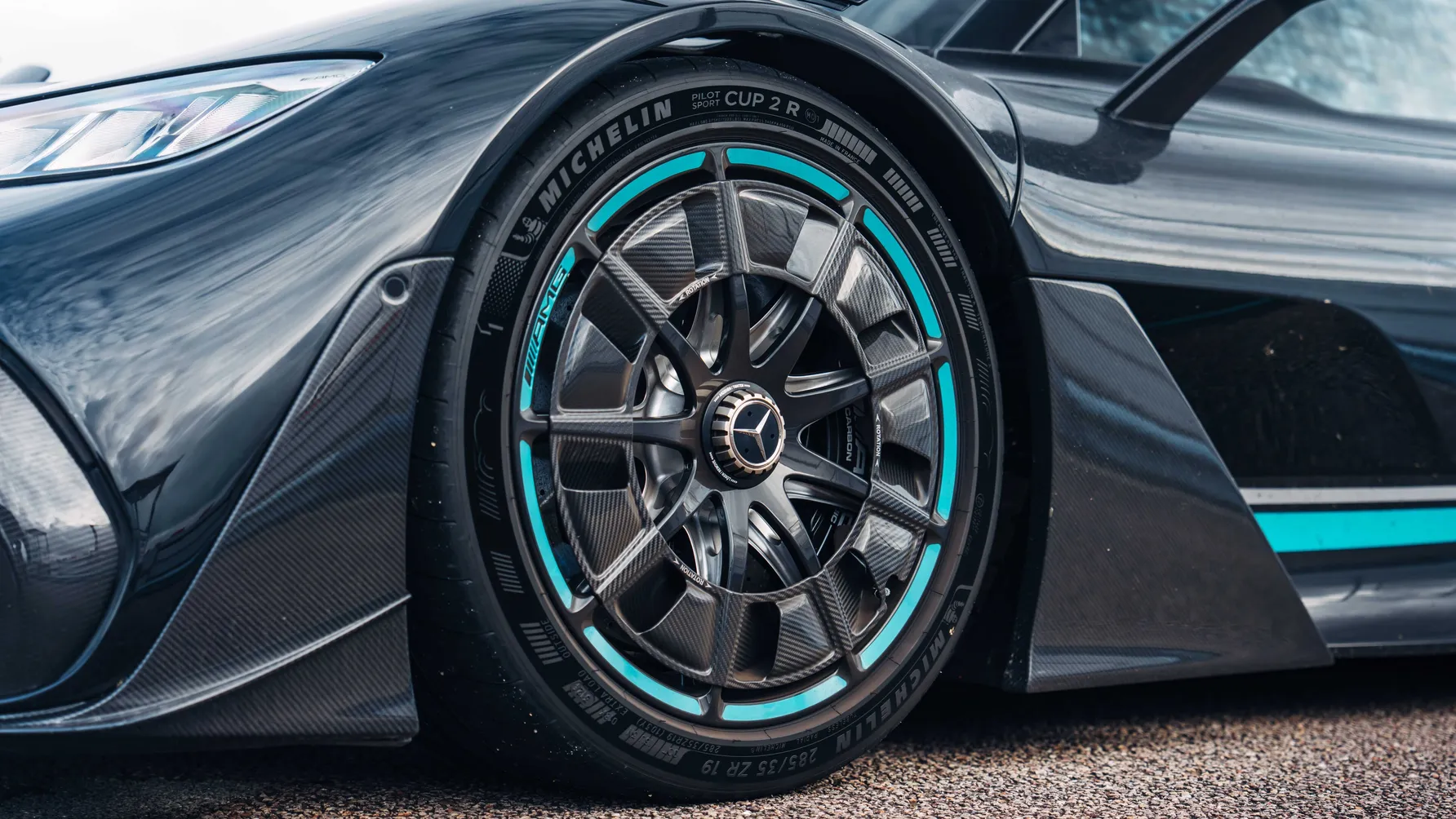
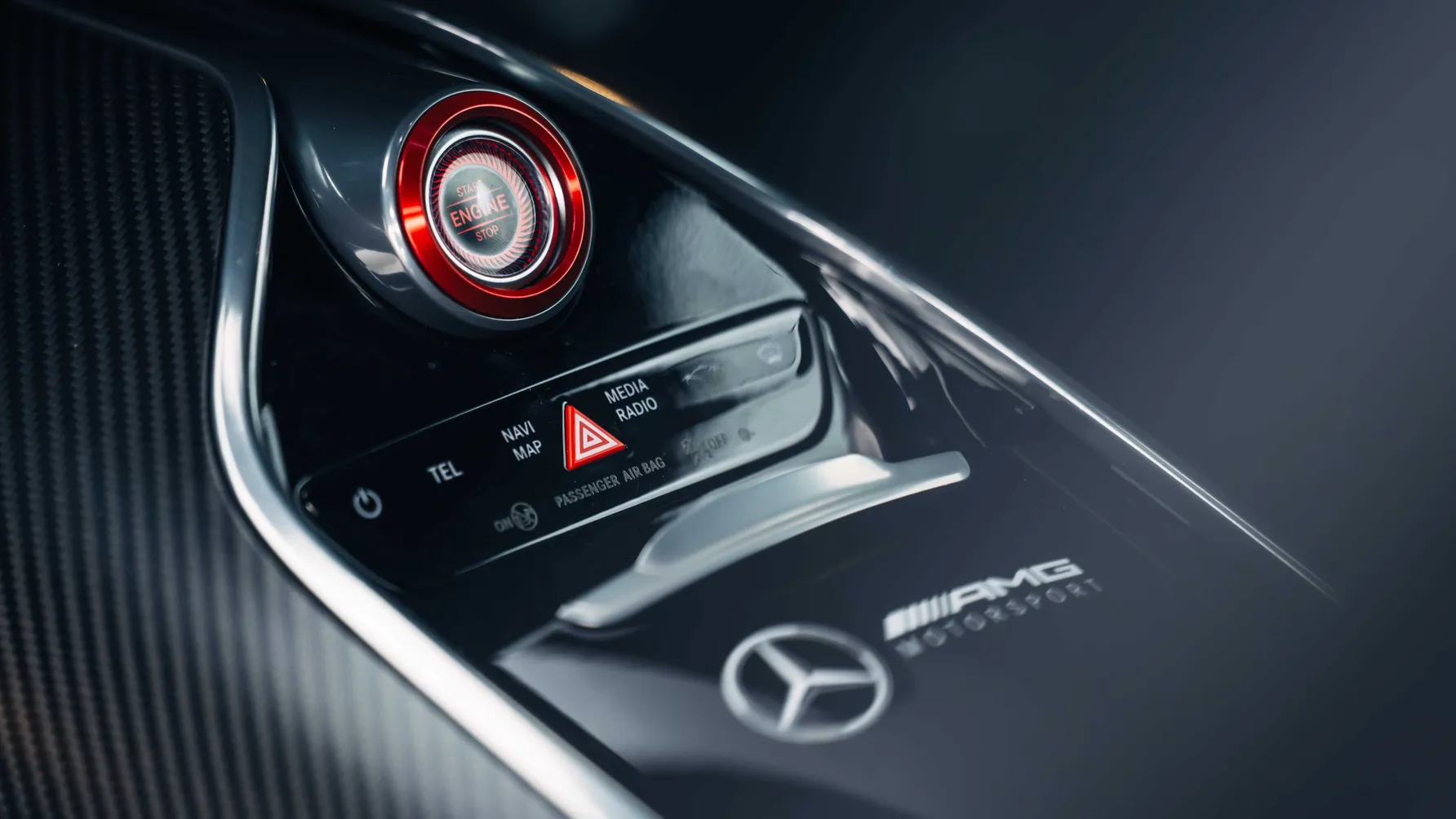
This is where the pushback against extremism must have started. The cabin is spacious, the windscreen broad, and there’s plenty of elbow room. The seat is shallow-sided and unsupportive. Easy to access, but provides no underthigh support. And why is the steering ‘wheel’ so massive? You can’t reach the DRS and neutral buttons with your thumb, which is surely the whole point. But: No haptics, and the Merc switchgear is attractive, good quality and functions just fine. It’s a much more complete cabin than the Valkyrie’s.
The messaging from the AMG, then, is mixed. If you know the technical backstory, what happens next won’t come as such a surprise, but if your experience has only been visual, taking in the sleek bodywork and awkward but manageable access, start-up is going to come as quite the shock.
Not for the fact that from cold you have to wait 50–60 seconds for the cats to preheat, but that once they have, I’ve never come across a car that sounds quite as broken at idle. It honestly made me think the crankshaft had snapped and was busily churning the engine internals to pieces. It’s awful. It turns out Lewis Hamilton won F1 championships with something that brought the sounds of a construction site to the pitlane.
We’re at Thruxton. It’s everything a Tilke track isn’t. Gritty, intimidating and puckeringly fast with zero friendly runoff. We’ve come here because it’s the United Kingdom’s fastest circuit and we want to feel the downforce. An F1 car has been here—but only once. In 1993, Damon Hill used his Williams FW15C to set an all-time lap record of 57.6sec at an average speed of 237kph. Dearie me. Honestly, if you haven’t been, come here, do one of the track experiences, and while you’re bricking yourself through the endless right after Noble, ponder that lap time.
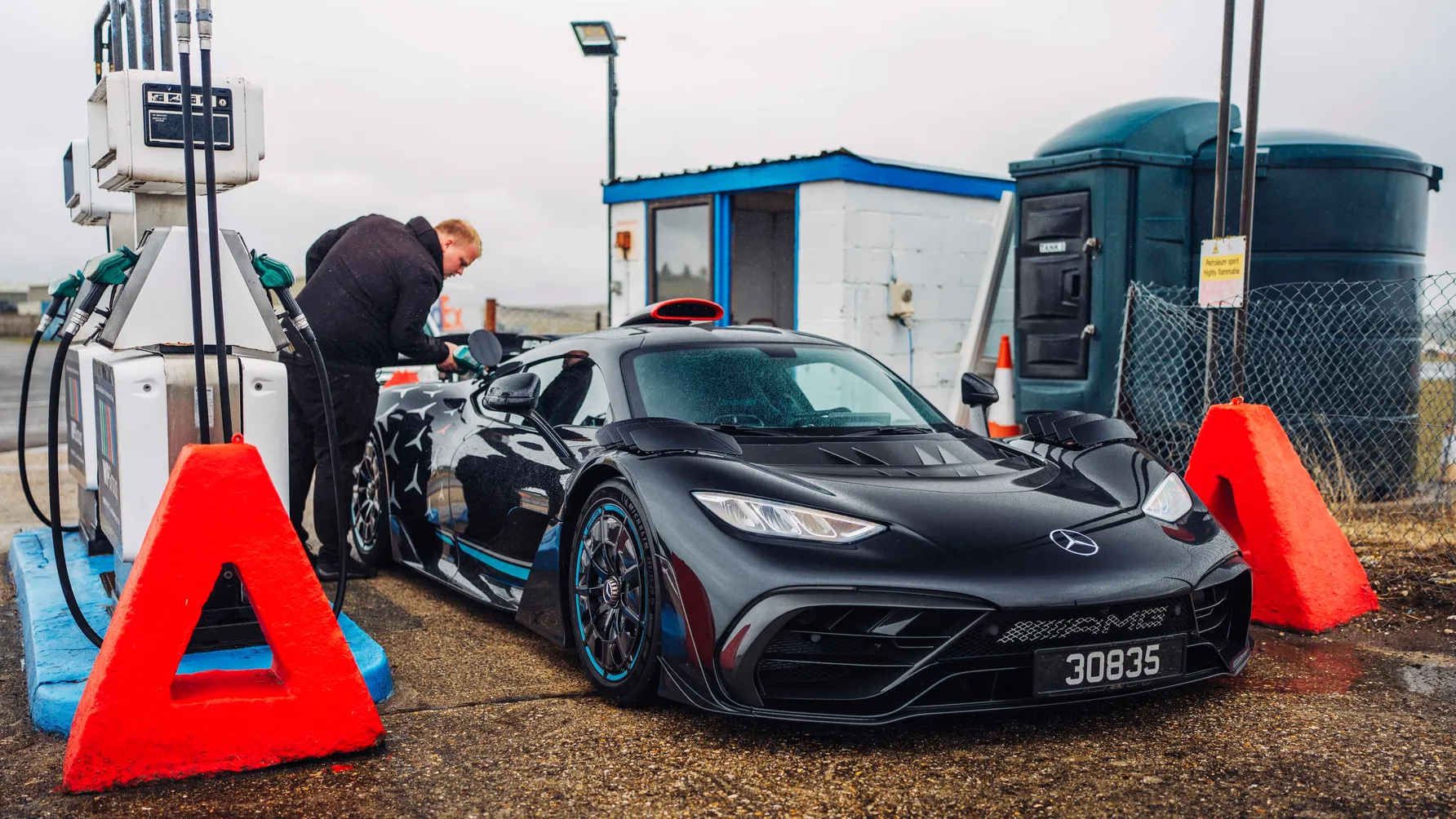
It’s pouring with rain, and both are wearing barely there track tires... since neither Jethro nor I fancy a trip across Thruxton’s endless grass, we amuse ourselves by weighing the cars. Full of fuel, the Valkyrie comes in at 1,340kg, the One at 1,745kg. Now, 405kg more is a lot. But let’s put this in context. The Valkyrie is a simple car—rear drive, V12 dominant and as stripped bare as a prison cell. It is a wheeled self-flagellation chamber (only there’s no room to swing the whip). Yes, the AMG has a smaller engine, but then there are the additions, most notably a pair of front electric motors and a much bigger battery pack—8.4kWh against 1.3kWh.
Everywhere you look, there’s just more of the Mercedes—more bodywork, more trim, more size, more kit, more complexity. And less clear thinking. The Aston comes across as a car that follows the ‘one-component/two jobs’ philosophy much more closely. Favorite feature? The front number plate mounting box doubles as storage for the medical kit. Or is it that the Valkyrie’s Venturi are so big that Ollie Kew and Jack Rix can insert themselves until only their lower legs protrude?
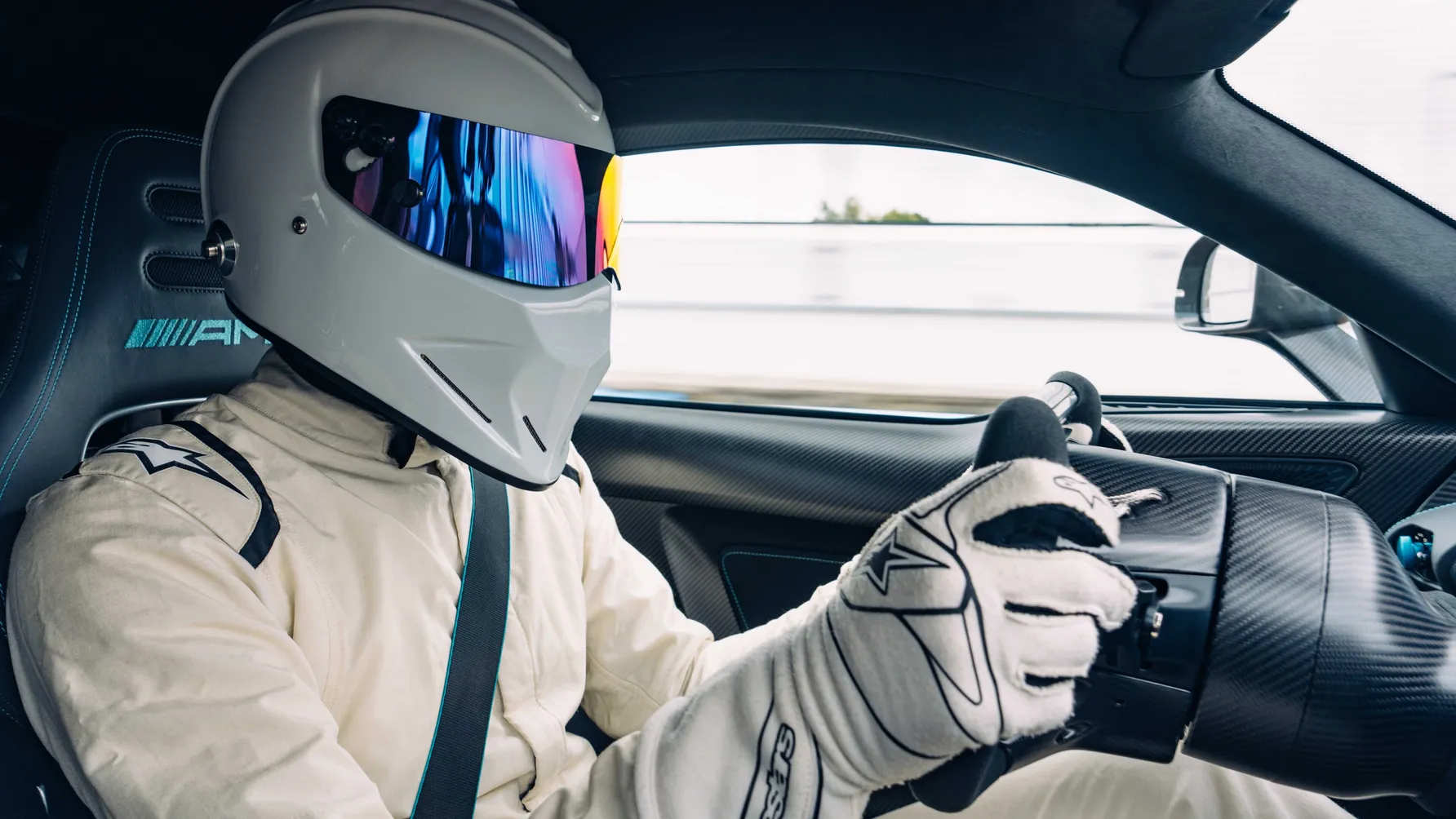
Exploratory laps. Jethro is in the Aston, I’m in the AMG. Looking out over the One’s steering yoke as the Valkyrie sets off ahead, I think how cool it would be for these two to do demo laps at an F1 race. If you could only hear them, you’d think new and old F1 cars were out together. And you’d be pining for the old one.
Of all the eras of F1 engines to choose to fit in a road car, why this one? It’s the least beguiling; the cars criticized for the way they sounded right from their first appearance in 2014. They are fascinating—the most thermally efficient engines ever invented—and it means the hybrid One aligns nicely with Merc’s current product range... but then the Valkyrie yowls round on its crusade to bring back F1 of the 1990s and we all lose our minds.
But here’s the thing: The AMG engine is never, ever, not for a moment, dull to drive. The selection of noises inside is bizarre—there are whizzes, chuffs, hums and cheeps as the powertrain makes unfathomable but important decisions behind you. You press the throttle, you feel the force, but what exactly is going on between the two is anyone’s guess. It’s not conventional, but it is exciting as 574 internally combusted horsepower gets jiggy with another 489hp from three e-motors (the 120hp fourth motor just drives the turbo).
There’s no lag, and with 4WD and killer torque, the AMG takes chunks out of the wriggling rear drive Valkyrie away from every slow corner. No need to chase the redline, just let the mid-range torque slam home and pin you back. Given its head, I reckon the AMG One has the widest effective powerband of any car I can think of—strong from 4,000rpm, here’s a turbo engine that does its best work around 8,000–9000rpm and is still fizzing with energy at 11,000rpm.
But actual acceleration? The Valkyrie has it licked. Relative to the AMG, it has the weight and frontal area of a paper dart, and even without pressing the ERS button for the extra 158hp e-Boost, is pulling 290kph on the run up to Club chicane. Air just seems to hit it differently, the porous Valkyrie spearing through it like it’s not there. It never feels like it’s subject to the same laws of motion and gravity as the AMG, and doesn’t drive like a car that has loads of downforce.
At high speeds, the steering doesn’t weigh up, you don’t get the impression the suspension is being compressed—mainly because it’s not, as the torsion bars and hydraulic actuators separate out the forces imposed on the car from beneath (potholes, compressions, etc) and above (downforce). So it flits around, the steering stays accurate and precise—the car always light and agile.
The AMG drives more conventionally. You sense drag play its part as acceleration starts to tail off, and you sense the downforce as the steering weights up significantly (even though the One also has trick inboard suspension that separates roll and lift movements). It’s the more reassuring car to drive through high-speed corners, locking itself to a line and refusing to be budged off it. It’s a tenacious thing, terrifically stable and secure, with more confidence-inspiring brakes and better turn-in than the Aston.
It’s the one I’m happier attacking Thruxton in. I don’t like the massive steering wheel or the sloppy seats, but with the powertrain yipping, gnashing and growling away and a knee-high view out that encompasses the open vents as water vapor steams out, the experience is full on. More Le Mans than F1, admittedly, but definitely motorsport: For me, the biggest takeaway from this test is that the AMG One is a genuine hardcore charger. It’s not going through the motions or claiming to be something it isn’t; it just loves being thrown at corners.
The single clutch gearbox is smoother, softer than the Valkyrie’s, the downshifts snappier and more convincing than the upshifts. I never bothered to drive it in Comfort mode, but fully ramped up, the suspension is stiff, skipping occasionally, letting you know it’s working hard. In Strat2 mode, it gives its all, and after a few laps, the electricity is depleted, but drop it to Race+, and it’s amazing how quickly it generates charge. It’s complex, fascinating to drive from start to finish.
The Valkyrie is a more elusive character. It flows beautifully around Thruxton, rides the curbs immaculately, gives you options for lines where the One only saw a single track, but there’s less feedback through the chassis and suspension at high speed, which makes it trickier to commit. The brakes are soft underfoot, the pedal a bit long, and it doesn’t bite into slow corners, despite the fact that it will happily oversteer on the brakes on the way in.
The AMG is the better-balanced car (witness its 50:50 weight distribution to the Aston’s 43:57), plus the more cohesive and understandable. I kept getting out of the Valkyrie feeling disoriented, not simply due to the banshee soundtrack but because its traits are so different from each other: Violent noise meets placid suspension, light steering meets riotous acceleration. The calmness and the ferocity. It’s so multilayered.
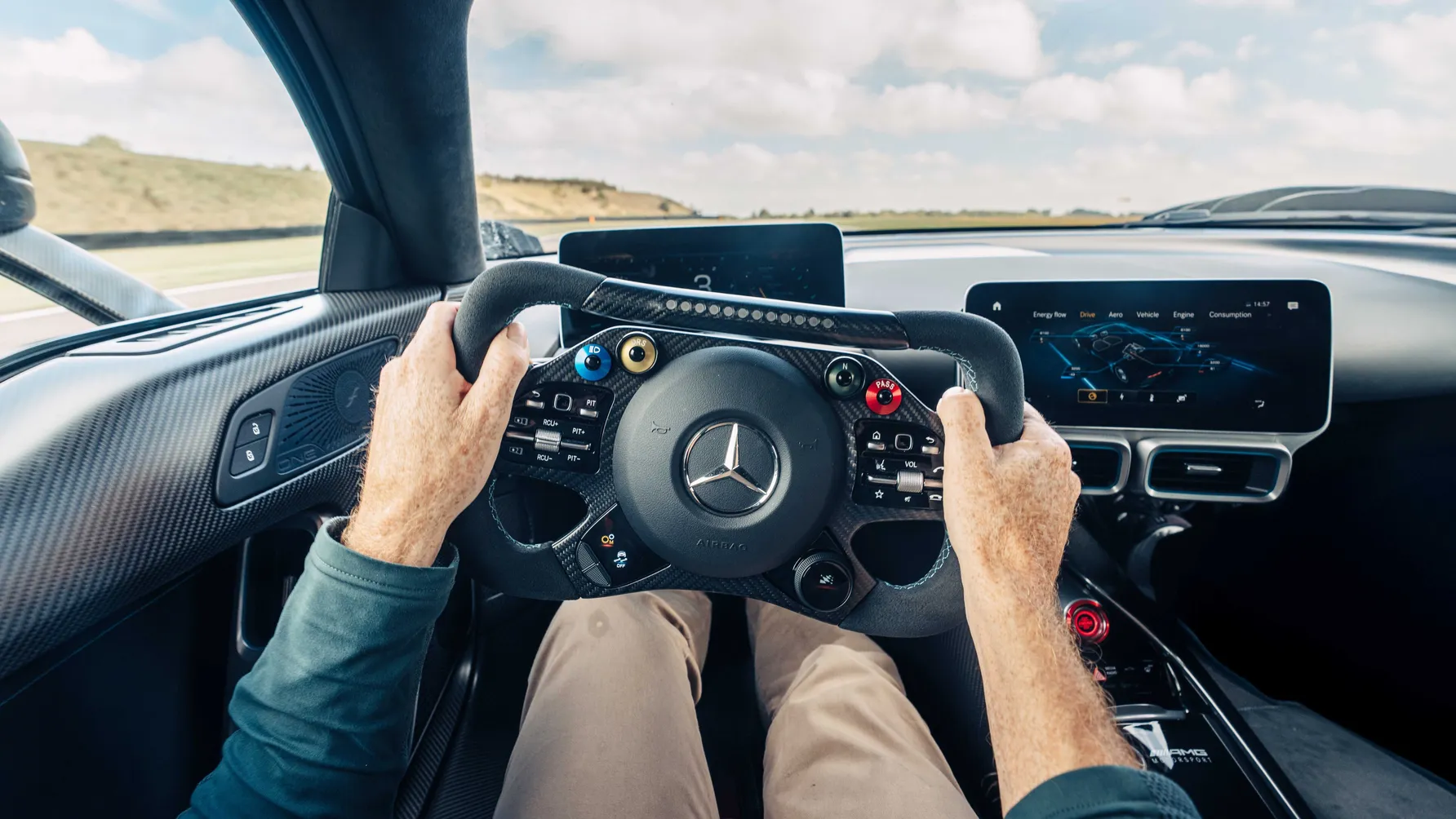
But so is the AMG. The calmness of the cabin and styling against the ferocity of the driving experience. As a car, the One really impressed me. My fear was that we were going to find it unreliable and unfinished. That Mercedes had been so burned by the protracted development and constant criticism that it had just shoved it out the door and collapsed, exhausted and disillusioned by the whole process.
Certainly, from the outside, it appears as though it wants to forget about the whole project. We have tried and tried to get a car from the company, but this one is borrowed from its extremely generous owner. And we’re going to celebrate it. Because what we’ve found is not unfinished or terminally flawed, in fact, it didn’t miss a beat for two days. Not one warning light, not one refusal to shift in and out of lizard mode. More than that, it’s an intriguing, fascinating car.
God knows what you’d do with it. Track days, hopefully like this owner. But George Russell’s use case seems more likely—getting about Monaco, car meets, coffee stops, days out, that’s about it. Same for the Valkyrie. No matter how they’re used, these two cars have kept their promise to road legalize F1 extremes. If it were my millions, I’d take the Aston for those looks, that sense it’s a one-off moment in history. And for the more effective ear defenders.
NOTE: This article first appeared on TopGear.com. Minor edits have been made.