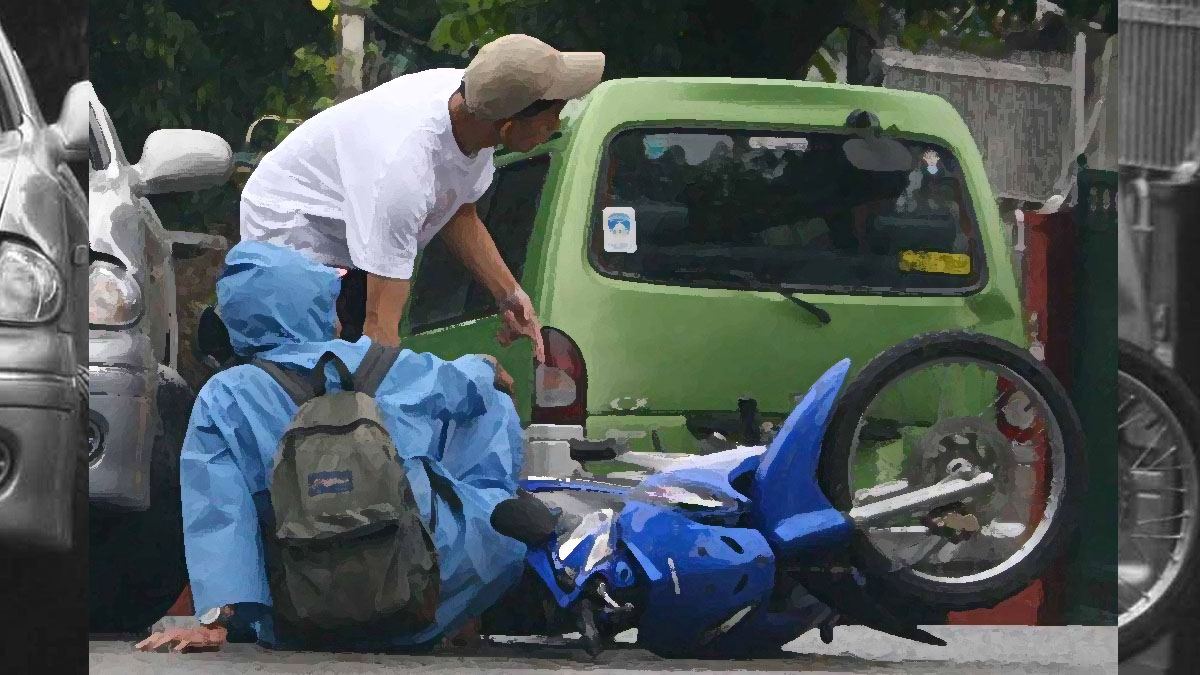
Do you know any seasoned rider who has never crashed a motorbike? If so, I’d be excited to meet him—he’s a rare bird.
For veteran riders, crashing a motorcycle or falling off one is a normal occurrence considering the numerous factors that make riding a dangerous undertaking. Tricycle drivers who make a U-turn without signaling, pedestrians crossing the street as they wish, open manholes, stray animals, abandoned roadwork areas—these are just a few of the common obstacles that riders encounter daily on Metro Manila’s pathetic road network. No matter how carefully motorcyclists ride, these obstructions make them more vulnerable to accidents compared with other road users.
To the riders out there: When all hell breaks loose and you’re lucky enough to survive the incident, we advise you not to get back on your bike right away and speed off as if nothing happened. Never presume your stallion is still in perfect condition; take a few minutes to inspect it for possible damages so as not to compromise your safety when you set off again toward your destination.
Make sure you’ve double-checked these 10 motorcycle parts before you restart the engine after a riding accident:
1) Headlamps, taillights, and turning lights
Even if you don’t notice any broken glass in the scene of the crash, check if these three lights are working. In case the impact affected the operation of these lights, you have to use hand signals whenever you wish to stop or make a turn so as not to be hit by the vehicles behind.
2) Engine oil; clutch and brake fluids
Determine if any of these three fluids are leaking. If there are signs of leakage, check how bad it is before riding off—you might need to top up the fluids to prevent the engine from knocking and to prevent clutch and brake failure.
3) Chain
Many novice riders believe that chains are unbreakable. This is not true. You might notice a missing chain link after the bike has crashed or tipped over. Don’t resume riding—the chain will likely snap because of this missing part, causing the motorcycle to stall.
4) Tires
Many bike crashes are triggered by all sorts of debris on the road. You’ll be surprised at what you might find embedded in the rubber—a rusty nail, a metal sheet, a razor blade. Don’t ignore this simply because you didn’t feel any change in tire pressure. After slowly and carefully pulling out the sharp object, pour water over the affected area to determine if there’s air leaking out from that section. If you notice bubbles coming out, take your bike to the nearest vulcanizing shop.
5) Side mirrors
You might feel fortunate to see your factory-installed side mirrors still intact after a mishap, but as you ride, they might start to rotate because of a loosened nut. Stop and address the issue first to prevent your side mirrors from rotating further as you gain speed. You’ll need your side mirrors to check for other road users and obstructions when turning, stopping, or changing lanes.
6) Front suspension
The front fork can be considered the most vulnerable part of a bike in a crash. We’ve seen lots of front forks that got bent or split into two due to strong impact. Also, a bent fork might cause your bike to pull right or left—and this becomes more dangerous the faster you go.
7) Frame/chassis
Since the motorcycle frame or chassis holds all of the motorcycle’s parts together, it must always remain in perfect condition. Many riders will attest that a bike’s chassis, especially those of underbones and scooters, ends up twisted after a crash. If you discover that the frame isn’t straight anymore, don’t ride the bike—it will be too difficult to control.
8) Brake and gear control pegs
Although they’re usually made of metal alloy, the brake and gear pegs are among the first components to get damaged when a bike is subjected to strong impact. And in case there’s nothing left for you to step on, use the passenger peg as a temporary replacement. I’ve witnessed a riding buddy removing a passenger foot peg and placing it alongside the brake pedal as a remedy. Believe me, it’s difficult to operate the rear brake or the
9) Brake and clutch levers
Like the brake and gear control pegs, the brake and clutch levers are very likely to get damaged in a motorcycle crash. If you feel the lever has become too short to press, look for a ballpen or a pencil that you can attach to the remaining part of the lever using adhesive tape. Make sure the adhesive tape is strong enough to secure this temporary lever extension.
10) Motorcycle wheel spokes
There’s also a big possibility that the wheel spokes become reduced to fragments during a crash. Unless there are enough spokes to keep the rim perfectly circular, do not attempt to ride the bike. Try to lift the front or rear part of the bike to be able to spin the wheel and check the rim’s condition. A wheel with many missing spokes will only result in a nasty, wobbly ride.
11) Handlebar
It could be a simple drop or a major crash, but the handlebar hardly ever escapes being damaged. Because it is a protruding part, it’s usually the first to hit the ground. After raising the motorbike, check if the handlebar is bent or misaligned. If the handlebar points to the left or to the right even if the front wheel is facing forward, ride around the block a few times to familiarize yourself with the altered steering behavior before picking up speed.
That’s your post-accident motorcycle safety checklist. Your next move? See a doctor