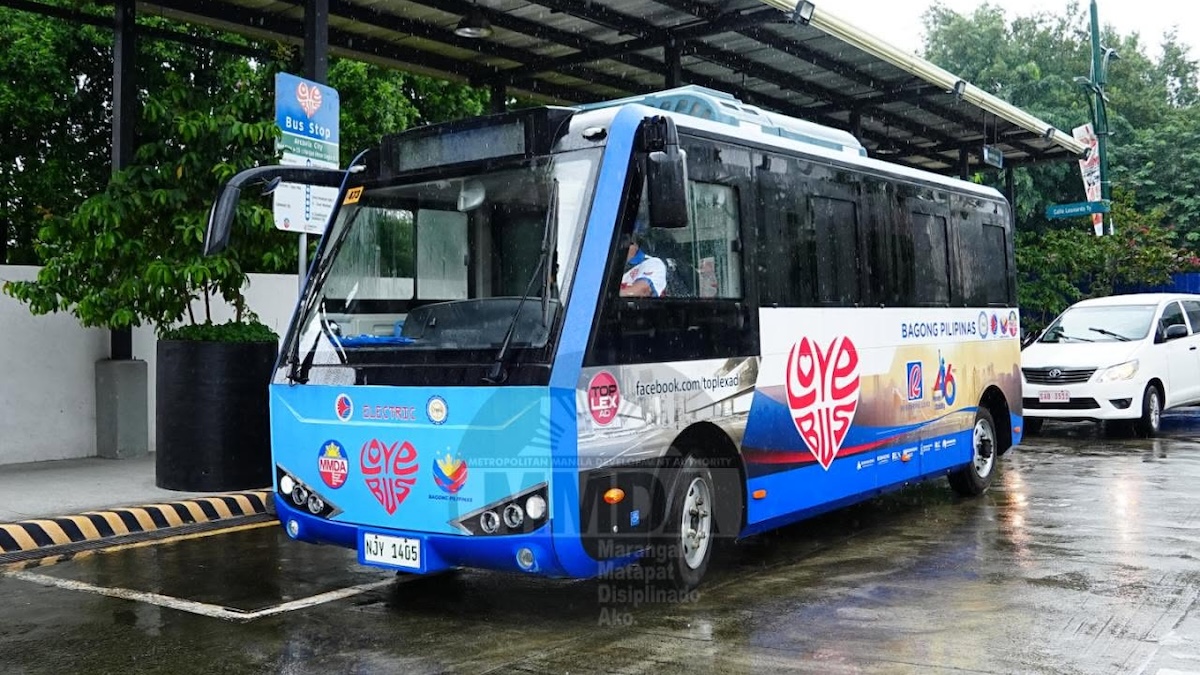
The iconic heart-adorned blue Love Bus, which once plied Manila’s streets decades ago, is making a comeback in electric form.
The Metropolitan Manila Development Authority has revived the Love Bus as a fleet of electric vehicles, with free rides along select routes to provide Filipino commuters another mode of public transport.
First Lady Louise ‘Liza’ Araneta-Marcos, along with MMDA chairman Atty. Don Artes, Mayor Vico Sotto of Pasig City, officials from Pasig City, other Metro Manila mayors, and partners from the private sector, attended the inauguration rites on Wednesday, September 9, 2026.
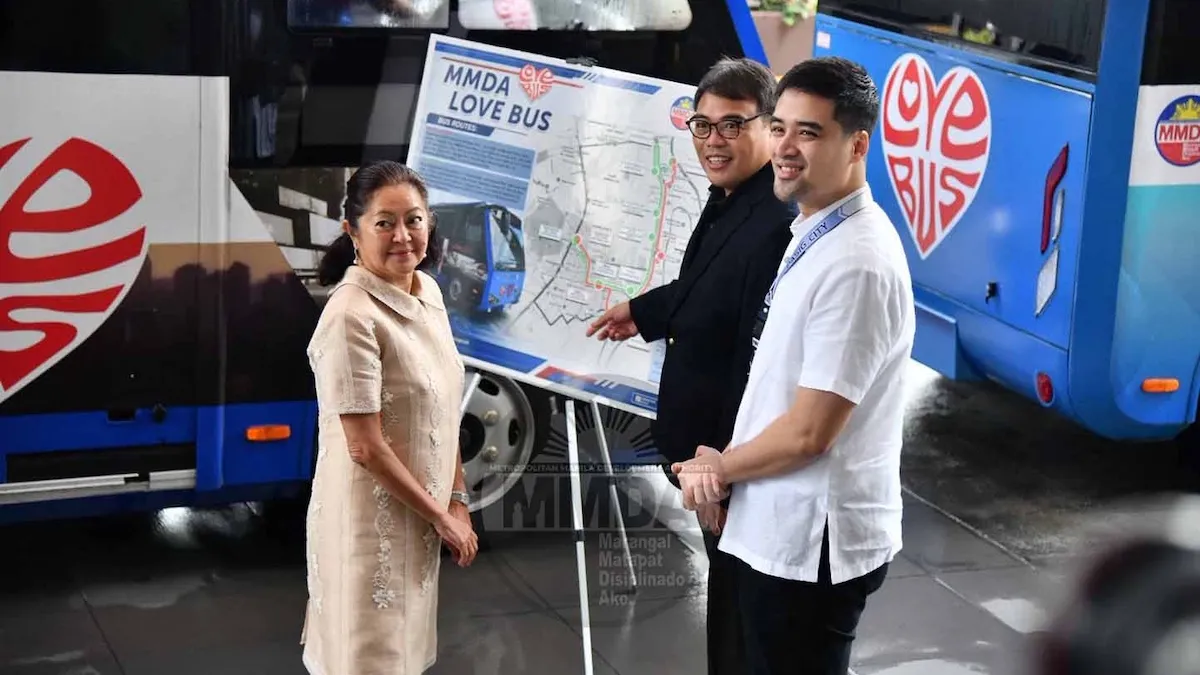
According to Artes, the latest projects “represent the MMDA’s commitment to building a more livable, resilient, and sustainable Metro Manila” in the transport sector. The transport agency also unveiled an interactive gallery and a new MMDA Annex Building at its headquarters in Pasig City on the same day.
OTHER STORIES YOU MIGHT HAVE MISSED:
ACMobility introduces EV safety program with nationwide rollout planned
Commuter etiquette 101: Avoid being noisy aboard public transport
Unlike the boxy, diesel-powered buses of the past, the modern iteration of the Love Bus now comes in the form of smaller zero-emission electric vehicles. There are currently six Love Bus units, with each one having the capacity to carry 36 passengers. Robinsons Malls, Megaworld, the City of Antipolo, and the Provincial Government of Rizal donated the said vehicles.
When will the new Love Buses start operations?
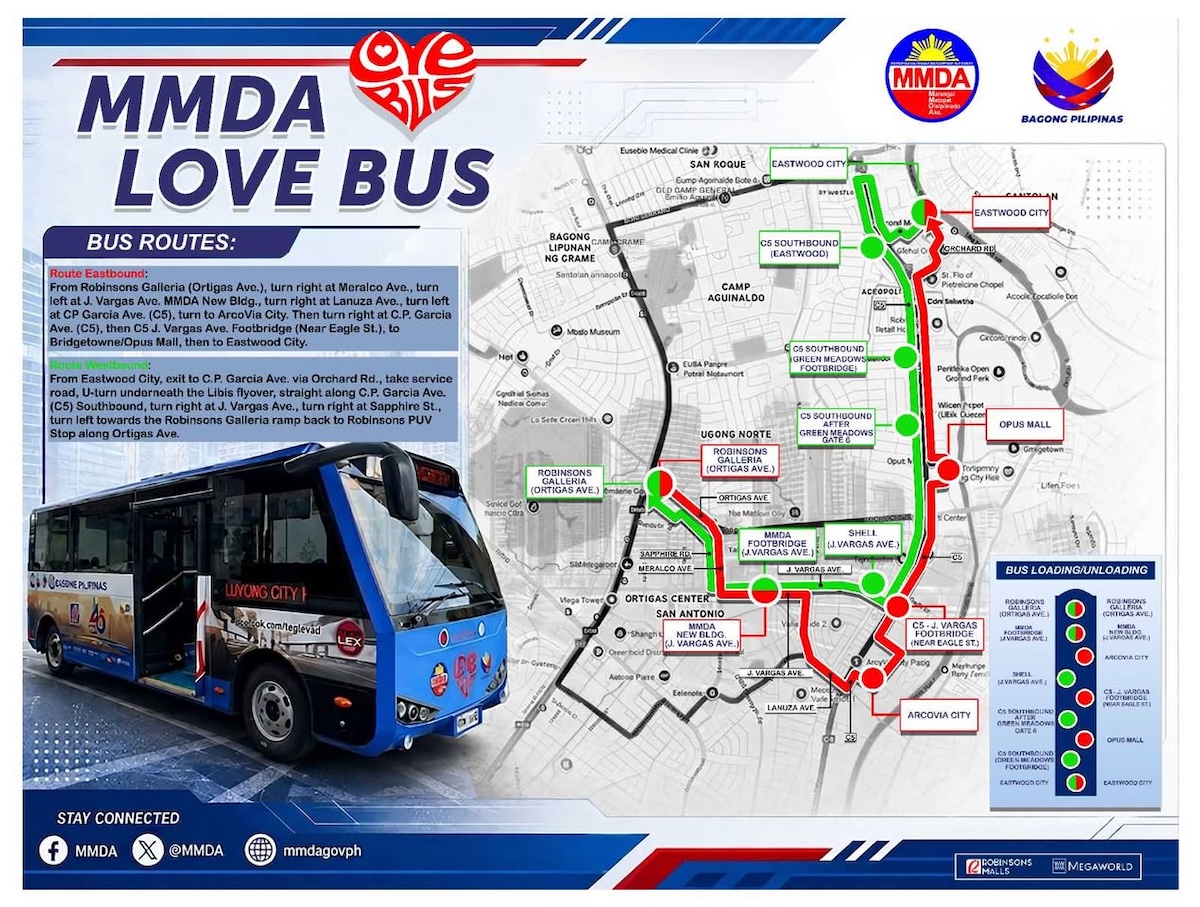
According to the MMDA, the current six-unit fleet will start operations on Thursday, September 10, 2026, running from 6am to 9pm. Free rides are now being rolled out between Robinsons Galleria and Eastwood City with the following specific routes:
Eastbound route
- Robinsons Galleria (Ortigas Avenue)
- Turn right onto Meralco Avenue
- Turn left onto J. Vargas Avenue: MMDA New Building
- Turn right onto Lanuza Avenue
- Turn left onto C.P. Garcia Avenue (C5)
- Proceed to Arcovia City, then turn right onto C.P. Garcia Avenue (C5)
- Proceed to C5–J. Vargas Avenue Footbridge (near Eagle Street), to Bridgetowne/Opus Mall, then to Eastwood City
Westbound route
- From Eastwood City, exit to C.P. Garcia Avenue via Orchard Road
- Take the service road and U-turn underneath the Libis flyover
- Proceed straight along C.P. Garcia Avenue (C5) southbound
- Turn right onto J. Vargas Avenue
- Turn right onto Sapphire Street
- Turn left toward the Robinsons Galleria ramp back to Robinsons PUV Stop along Ortigas Avenue
Designated stops will have waiting sheds for commuters’ convenience.
The MMDA is also studying proposals to expand the Love Bus operations, specifically along underserved routes. “Since rides are free, we need to ensure that the Love Bus won’t compete with route franchises and that there are passengers to be served and no public transportation will be affected,” said Artes.
Where will future Love Bus routes pass?
In the pipeline are routes covering Makati City Hall–Mandaluyong City Hall–Pasig City Hall; Estancia West Wing–Uptown Transport Terminal; and Eastwood Mall–UP Diliman.
The MMDA says it is in the process of purchasing more Love Bus units to accommodate more passengers.
What happened to the original Love Buses?
History buffs may recall that the original Love Bus was first introduced back in the ’70s under the administration of late President Ferdinand Marcos Sr. It was a signature project of then-First Lady and Metro Manila governor Imelda Marcos. It was considered revolutionary when it launched, as the first air-conditioned buses in the country and with its ‘no standing on the aisle’ policy.
As cited in ‘The Rise and Fall of the Love Bus (and the Ghosts of Bus Reforms Past)’ by Rene Santiago, published in The Philippine Transportation Journal (December 2021), the Love Bus was originally conceived as a solution to the chaotic urban public transport. “It burst into the scene in 1976, captured the hearts of jaded commuters, and then flickered out after a decade of bright shining moments,” wrote Santiago.
To make a difference, the air-conditioned monocoque buses were designed to operate on a flat fare and a fixed schedule. This was to ensure the service would be attractive to car users and convenient for the commuting masses. The name was said to have been inspired by a popular Hollywood movie at the time, The Love Bug.
While it was well received at launch, historical records show that in the first four years of its operation, the company accumulated a deficit of over P140 million.
However, a sharp decline in the number of buses in operation between 1983 and 1987 led it to eventually cease operations in the ’90s.