When it comes to air travel, we’ve all heard the horror stories of passengers’ travel plans being ruined due to canceled and delayed flights. Incidents of lost luggage at the airport, overbooking or flights, and misleading fare advertisements are also common occurrences. While most travelers have learned to accept these realities without question, there are many instances when you’re actually entitled to some form of compensation.
In case you didn’t know, there’s such a thing called the Air Passenger Bill of Rights (APBR) in the Philippines that protects people flying in and out of the country. Here’s everything you’re entitled to get when it comes to air travel.
ALSO READ:
Explainer: What does ‘State of National Energy Emergency’ mean?
PBBM signs bill allowing him to reduce or remove fuel excise taxes
What is the Air Passenger Bill of Rights?
The Air Passenger Bill of Rights is a set of rights outlined by The Department of Transportation (DOTr) and Department of Trade and Industry (DTI), in partnership with the Civil Aeronautics Board (CAB) that seeks to protect air passengers from various airport problems.
The rights are based on Joint DOTC-DTI Administrative Order No.1 Series of 2012, with the updated Air Passenger Bill of Rights amended as a result of comprehensive consultations with various stakeholders, including airlines, consumer advocacy groups, and the general public.
According to CAB, the amendments address several key areas of passenger rights, including but not limited to, compensation for delays and cancellations, clearer communication protocols, setting threshold on overbooking, and on-time performance reporting of air carriers.
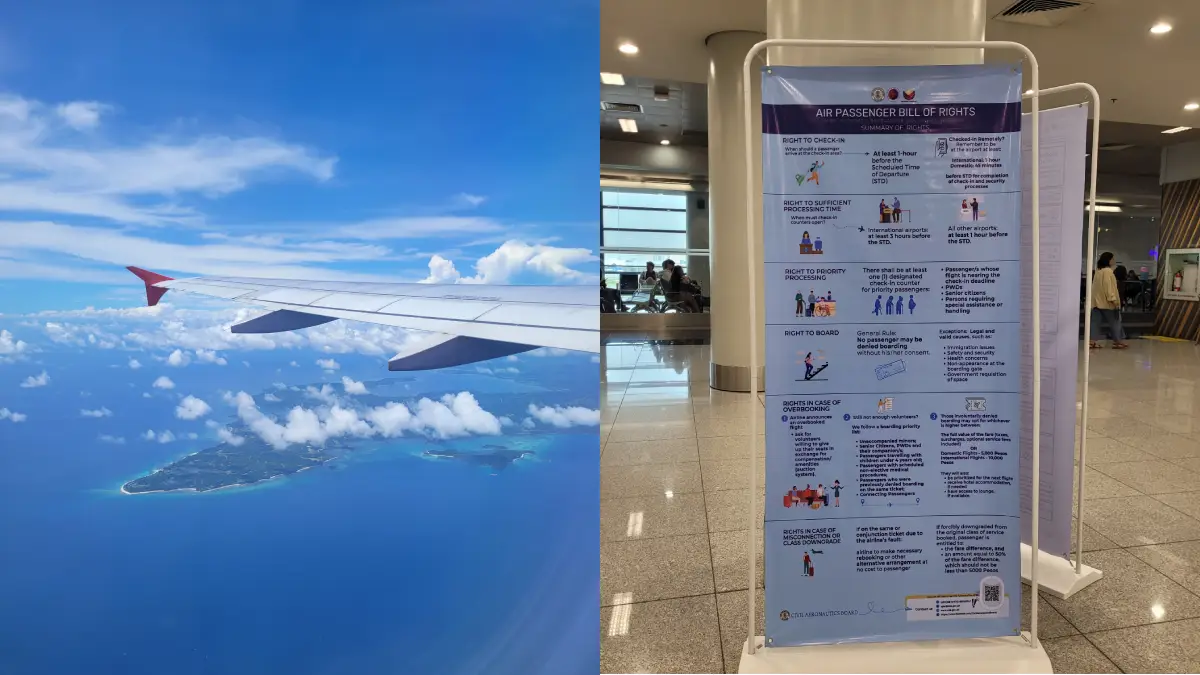
You can find copies of the summary of the rights posted around airports like the Ninoy Aquino National Airport (NAIA) and can download the entire 27-page document here.
So what exactly does the bill cover? Under the Air Passenger Bill of Rights as amended, a traveler has three major rights:
- Passengers have the right to be provided with accurate information before purchase
- Air passengers have the right to receive the full value of the service purchased
- Lastly, passengers have the right to compensation—which we’ll get into the specifics of below
1) Right to be provided with accurate information before purchase
Under this right, a passenger is entitled to a complete, clear, and fair disclosure of the terms and conditions that come with the ticket purchase. Such disclosure should include the documents required for check-in, refund, and rebooking policies, procedures, and responsibility for delayed and/or canceled flights.
The terms and conditions should be available for review on the air carrier’s website or other documents that may be sent to the passenger via post or email.
This section of the bill also includes the right to clear and non-misleading advertisements and important reminders regarding fares. Air carriers are required to disclose other costs such as baggage allowance, mandatory fees and charges, government taxes, and fuel surcharges, and should publish fare advertisements that are clear and not misleading.
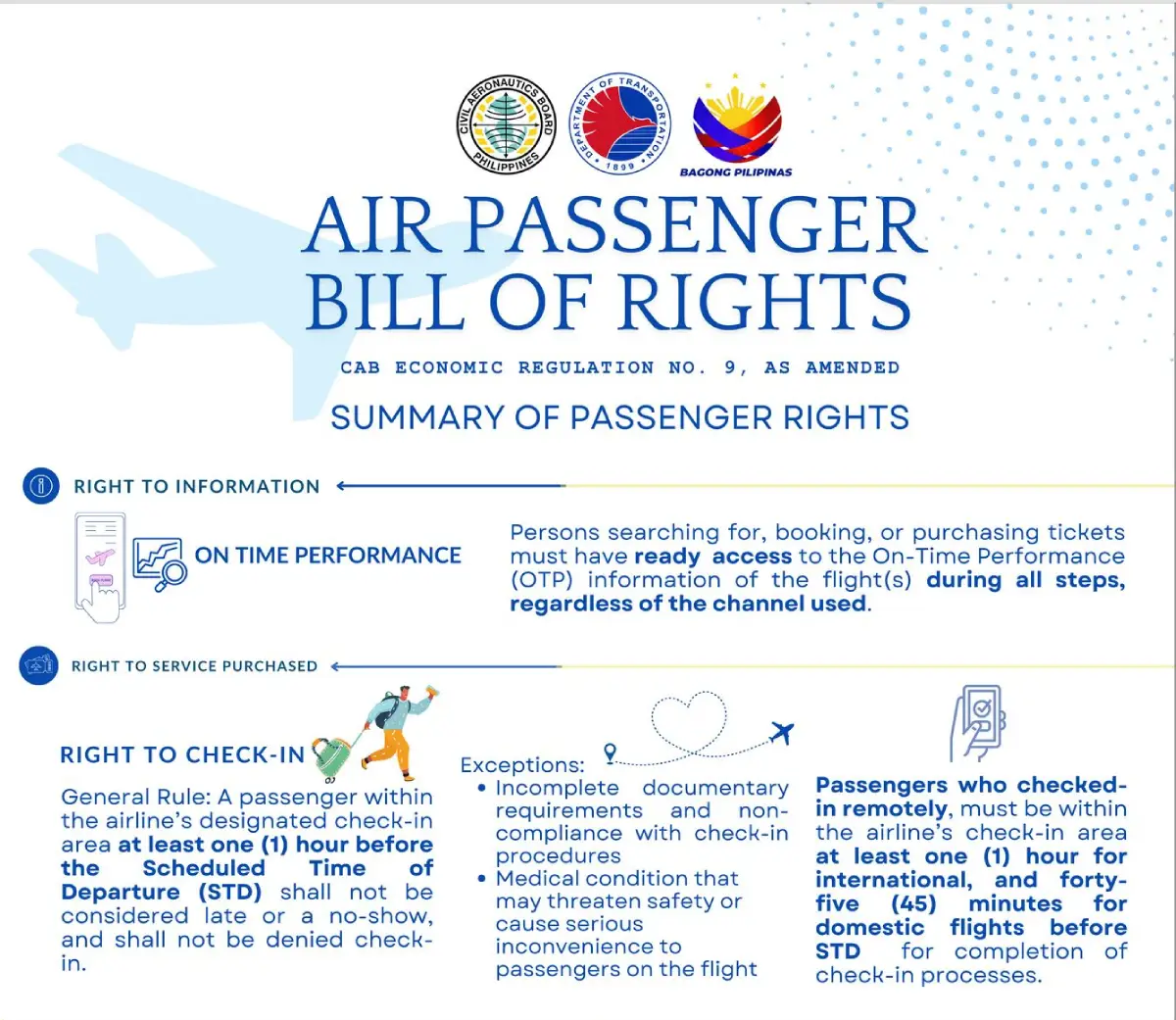
Under the amended regulation, persons searching for booking, or purchasing tickets must have ready access to the On-Time Performance (OTP) information of the flights during all steps, regardless of channel used.
2) Right to the receive the full value of the service purchased
According to the ‘full value,’ airline passengers in the Philippines are entitled to the following:
a) Right to transportation and baggage conveyance
Every passenger is entitled to transportation, baggage conveyance and ancillary services, in accordance witht eh terms and conditions of contract of carriage with the air carrier. This means that any violation, due to the fault or negligence of the air carrier, should entitle passengers to compensation or alternative arrangements acceptable to the passenger.
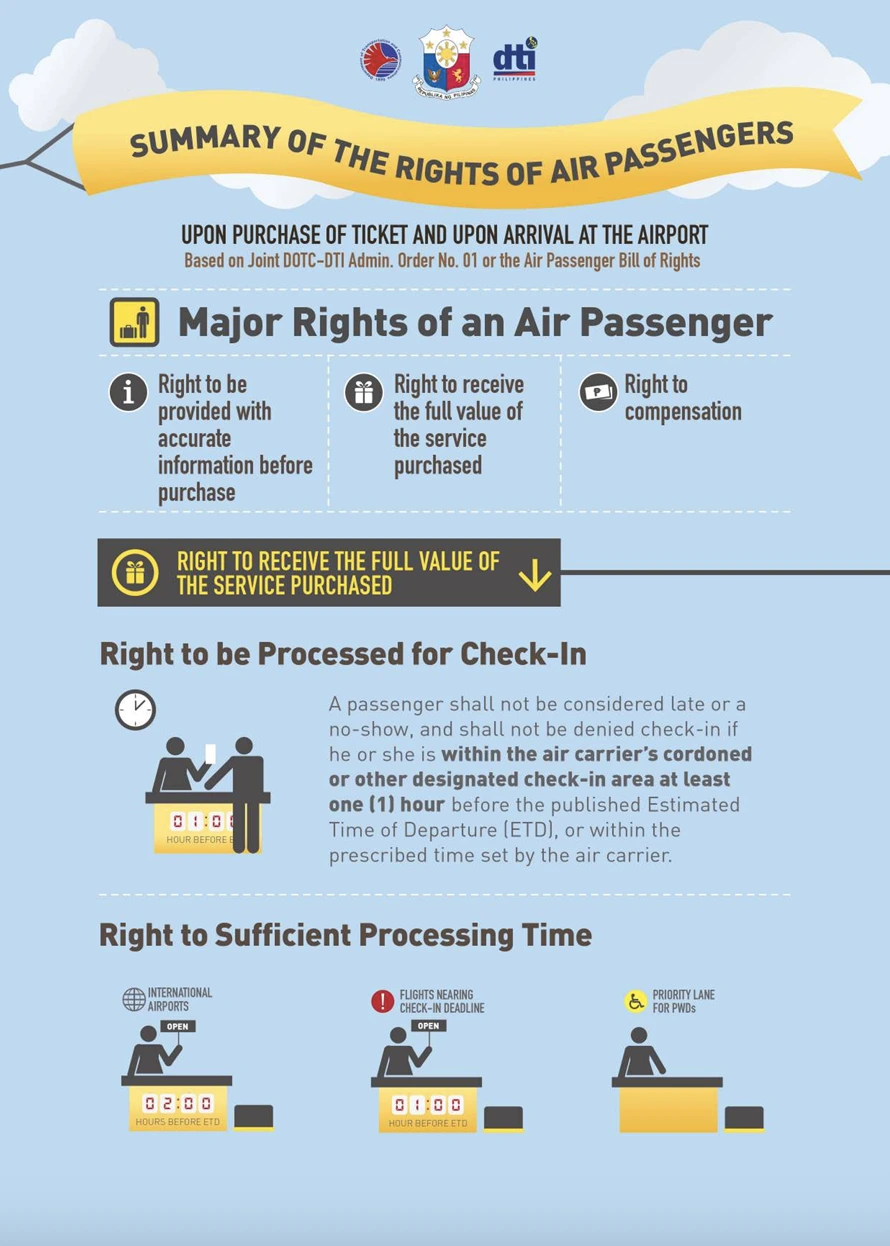
b) Right to be processed for check-in
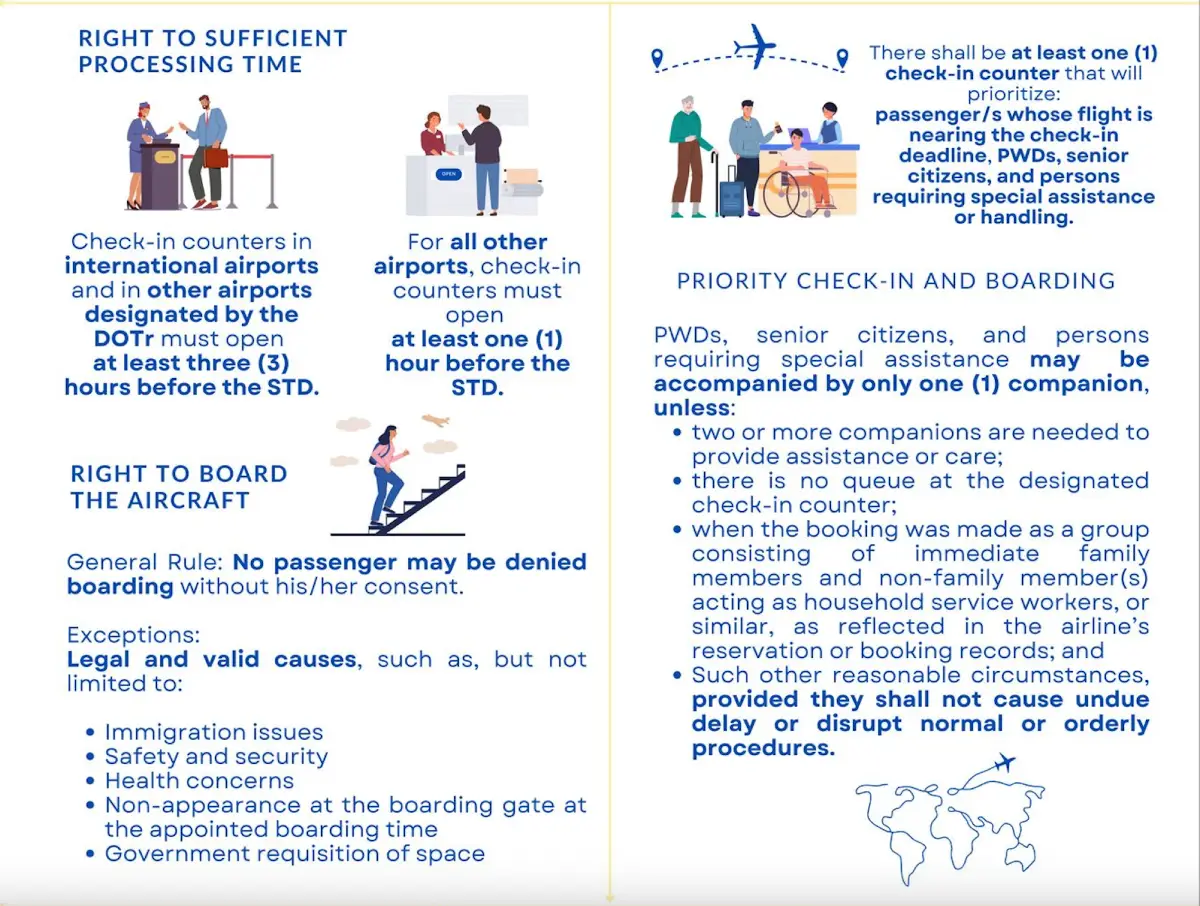
Passengers should arrive at the check-in area at least 1 hour before their scheduled time of departure. This applies even to those who choose to check in remotely or online. For international flights, passengers should still arrive at least one hour before their flight, while domestic passengers should arrive 45 minutes before their scheduled time of departure to complete the check-in and security processes in a timely manner.
If lines at check-in counters are too long, the air carriers must ensure that passengers within the designated check-in area are prioritized before the check-in deadline.
c) Right to sufficient processing time
All air passengers have the right to sufficient processing time to complete their check-in requirements and final security processes. This means that for international flights, check-in counters must open at least 3 hours before the scheduled time of departure. For domestic flights, the counters should open at least 1 hour before the departure time.
d) Right to priority processing
According to the bill, there should be at least one (1) designated check-in counter for priority passengers. These include passengers whose flights are nearing the check-in deadline, Persons with Disabilities (PWDs), Senior citizens, and persons requiring special assistance or handling, including their companions.
The air carrier shall likewise coordinate with authorities for the use of proper equipment, entryways, and aerobridges, when available, to aid in the boarding and/or disembarkation of said passengers needing special assistance. However, under the bill, it is the responsibility of a PWD to declare his/her need for special assistance or handling to the airline upon booking a flight, to ensure that such services can be provided.
e) Right to board the aircraft for the purpose of the flight
Section 11 of the bill covers cases of overbooking and being denied boarding at the check-in counter or gate.
Under this right, no passenger may be denied boarding without their consent except in certain legal and valid causes, such as “immigration issues, safety and security, health concnerns, non-appearance at the boarding gate at the appointed boarding time and government requisition of space.”
Other than these causes, no passenger may be denied boarding without their consent.
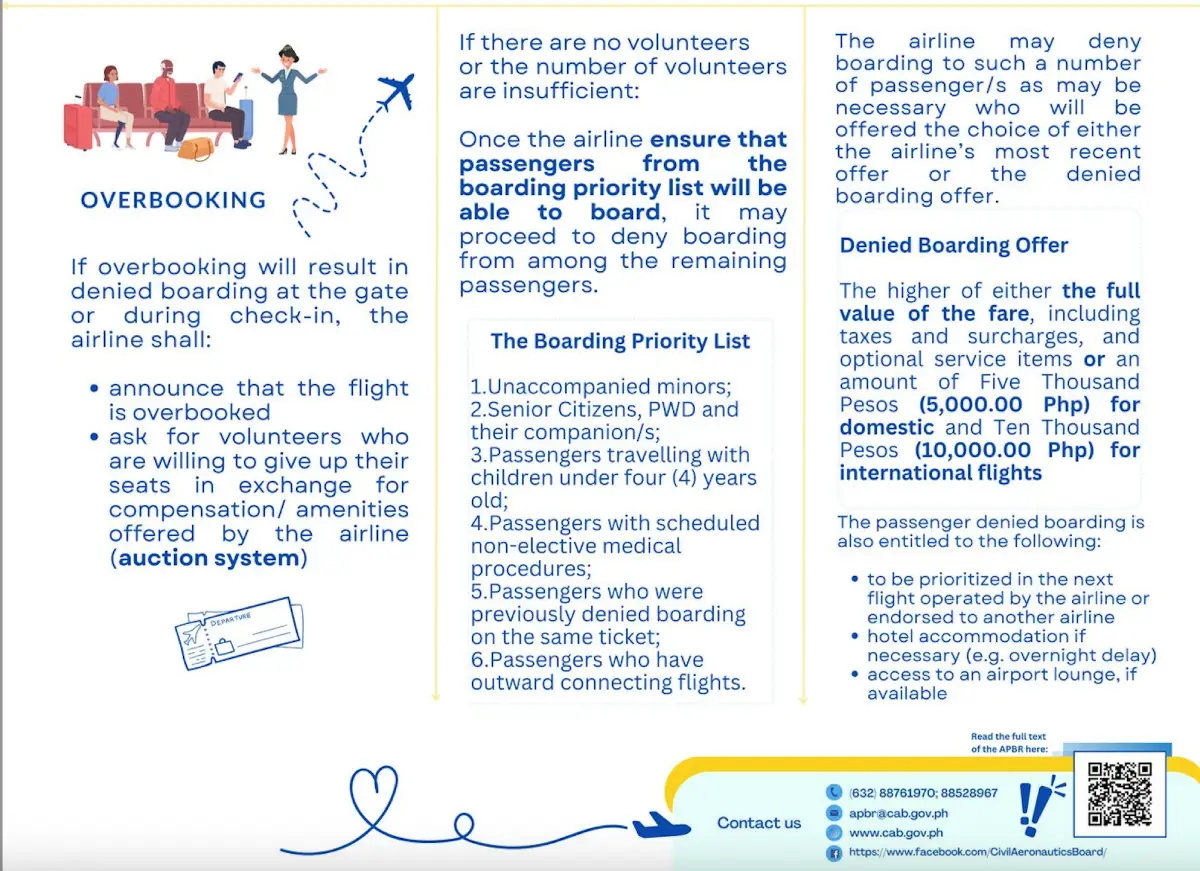
Overbooking is a globally recognized and accepted practice of air carriers of selling more tickets than the number of seats on the plane to compensate for no-show passengers. However, in the event that all passengers show up and all seats are filled, the air carrier must look for volunteers who are willing to give up their seats in exchange for some form of compensation. This could include priority booking in the next flight, being endorsed to another air carrier upon payment of any fare difference, and/or a cash incentive.
But if the number of volunteers is not enough, the air carrier shall employ an “auction system.” To get volunteers, the air carrier must increase the compensation package or amenities offered until the required number of volunteers is met.
In the case of overbooking, air carriers may deny boarding to some passengers, but must bear the cost of additional expenses and inconvenience to affected passengers.
Based on the amended bill, offers could include:
- The higher of either the full value of the fare, including taxes and surcharnges and optional service items or an amount of P5,000 for domestic and P10,000 for international flights;
- Priority boarding for next flight or endorsement to other air carrier;
- If necessary, hotel accommodation (for overnight delays) or access to an airport lounge, if available.
In the case of government requisition, passengers may have to forego their confirmed space on a voluntary basis. However, government requisition may only be done for official government purposes, with a written request justifying the requisition. The air carrier also has the right to claim the full fare of seats requisitioned by the government entity.
3) Right to Compensation
If you find yourself with canceled or delayed flights, or delayed, lost, or damaged baggage at the airport, you can invoke your right to compensation.
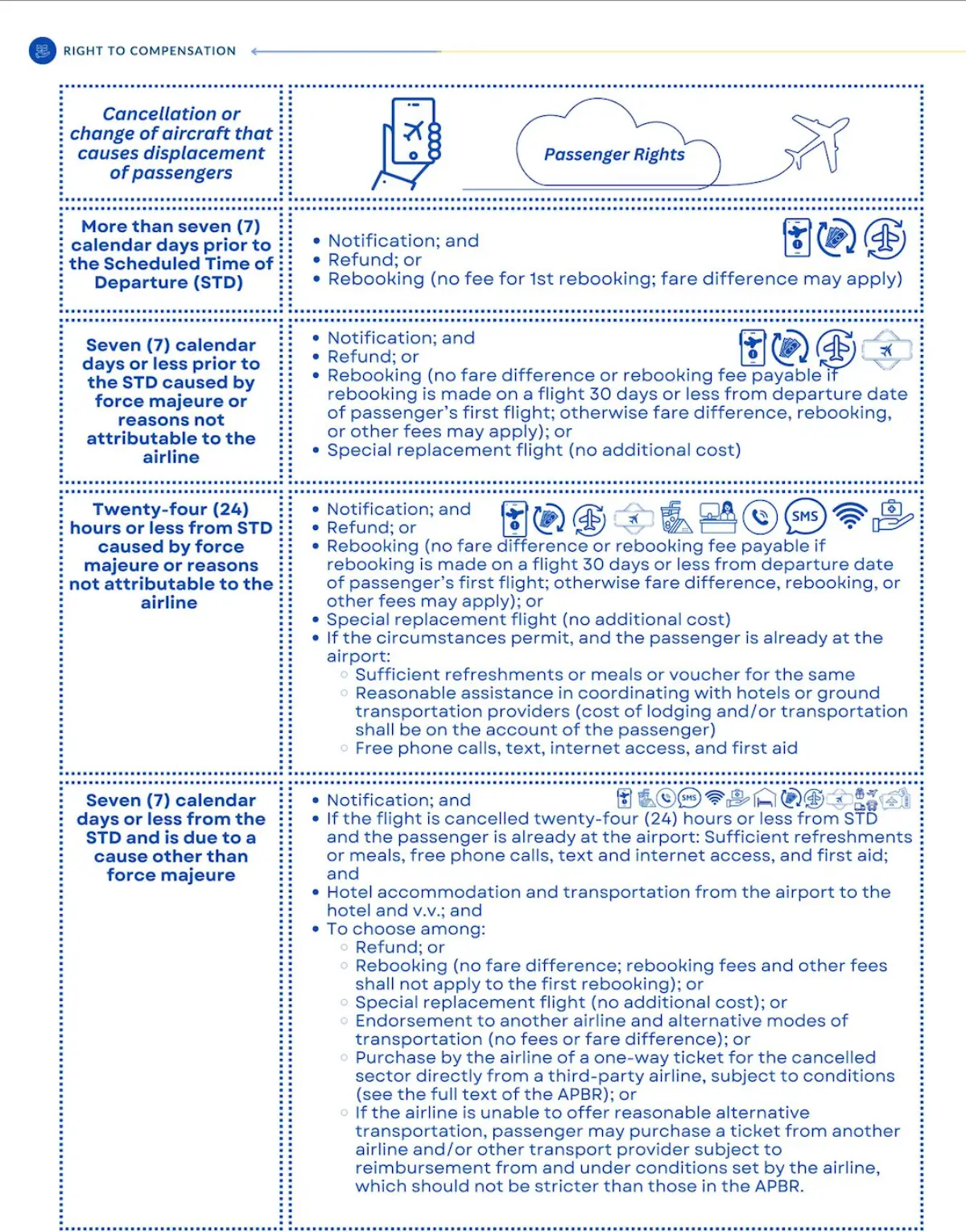
Right to compensation and amenities in case of flight cancellation
If the air carrier cancels the flight at least 24 hours before the ETD, the passenger has the right to be notified about it. In this case, the air carrier shall rebook or reimburse the passenger, at the option of the latter. According to the bill, passengers should be reimbursed for the value of the airfare, taxes, surcharges, and other optional fees if they decide not to fly the ticket or all the routes/sectors.
If the air carrier cancels the flight less than 24 hours before the ETD, the passenger has the right to be notified about it. Passengers must be endorsed to another air carrier without paying any fare difference, provided that reaccommodation is allowed.
Passengers are also entitled to rebook tickets without additional charges to the next flight with availability, or within thirty days, to a future trip within the ticket’s validity period.
If the passenger is already at the airport at the time of the announcement of the flight cancellation, they also have the right to certain amenities. This could include refreshments (food, drinks, or a voucher for the same), hotel accommodations (which should be conveniently accessible from the airport), transportation from the airport to the hotel and vice versa, free phone calls, and first aid if necessary.
Take note that certain amenities only applies in cases where the cancellation is attributable to the carrier. If the cancellation is due to other causes, such as force majeure and safety or security reasons, as certified by the Civil Aviation Authority of the Philippines, the passenger only has the right to be reimbursed for the full value of the fare.
Right to compensation and amenities in case of flight delay, forced downgade and exceptions
In case of terminal delays that last at least two (2) hours after the ETD, whether or not such is caused by the air carrier, the passenger has the right to avail of refreshments or meals; right to free phone calls, texts, emails, and first aid if applicable. Passengers also have the right to rebook or refund their ticket, and the right to be endorsed to another carrier.
If the terminal delay takes at least four (4) hours after the ETD and is attributed to the air carrier, the passenger has the right to consider the flight canceled for the purpose of availing the rights and amenities provided in case of actual cancellation.
In this case, passengers have the right to additional compensation equivalent to at least the value of the sector delayed (to be paid in the form of cash or vouchers at the discretion of the air carrier). They also have the right to board the flight if it takes more than six hours after the ETD and the affected passenger has not chosen to rebook and/or refund.
If the tarmac delay is at least three (3) hours after the ETD, the passenger has the right to sufficient food and beverages, accurate announcements and communication services.
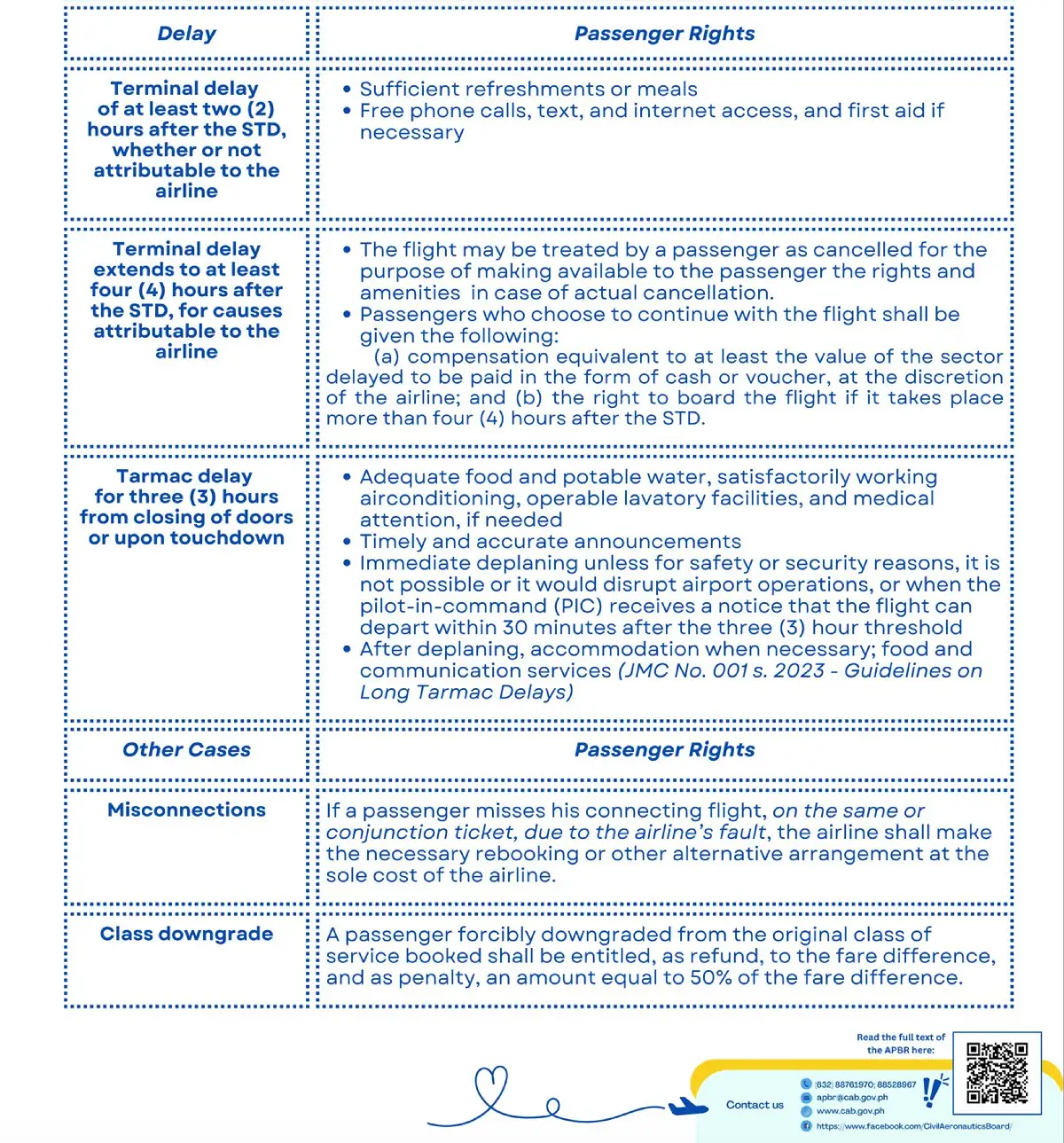
Furthermore, if passengers with connecting flights, miss flight connections due to the air carrier’s fault, the carrier must make the necessary flight rebookings or other alternative arrangements at its cost and expense to allow passengers to reach their destination.
Additionally, passengers forcibly downgraded from their original class, are entitled to fifty percent (50%) of the fare difference of the actual fare paid by the passengers (including all taxes, fees, surcharges, and optional service items) and the average of all airfares.
Right to compensation for delayed, lost, and damaged baggage
Passengers also have the right to avoid the inconveniences, including delayed, offloaded, damaged, or lost luggage at the airport. Under the bill, the air carrier must carry the offloaded baggage in the next flight with available space and deliver the same to the passenger either personally or at his/her residence. The passenger is also entitled to the following:
- To be notified of the offloaded baggage and reason
- P2,000 compensation for every 24 hours of baggage delay for the incovenience
- If luggage is lost or damaged at the airport attributable to the air carrier, the relevant convention will apply to international flights.
- For domestic flights, the passenger has the right, upon proof, “a maximum amount equivalent to half of the amount in the relevant convention (for international flights) in its peso equivalent.”
For compensation purposes, a passenger’s baggage is considered “permanently and totally lost” if it’s not delivered within a period of seven days.
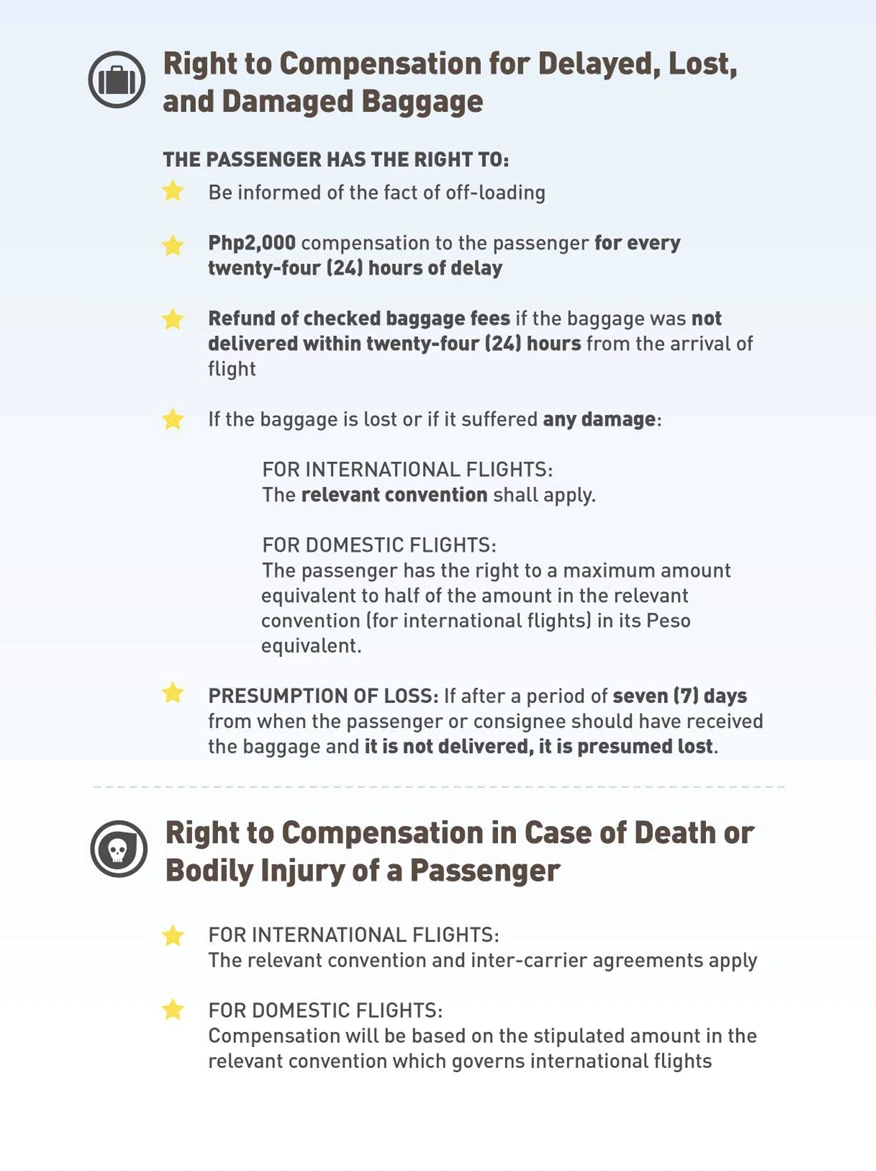
Right to compensation in case of death or bodily injury of a passenger
In case of death or bodily injury during an international flight, the relevant convention and inter-carrier agreements shall apply. In case death or bodily injury happens during a domestic flight, the compensation will be based on the stipulated amount in the relevant convention that governs international flights.
Right to prompt payment of compensation
With this right, air carriers should make the payment available to the affected passengers in a timely manner. Passengers may claim payment at the air carrier’s counters at the airport on the date the incident occurred, at the air carrier’s main office, at any other branch, or by other means regularly used by the air carrier to transact business with passengers. Air carriers are mandated to inform passengers about their compensation mechanisms and, claim-filing deadilnes and other processes.
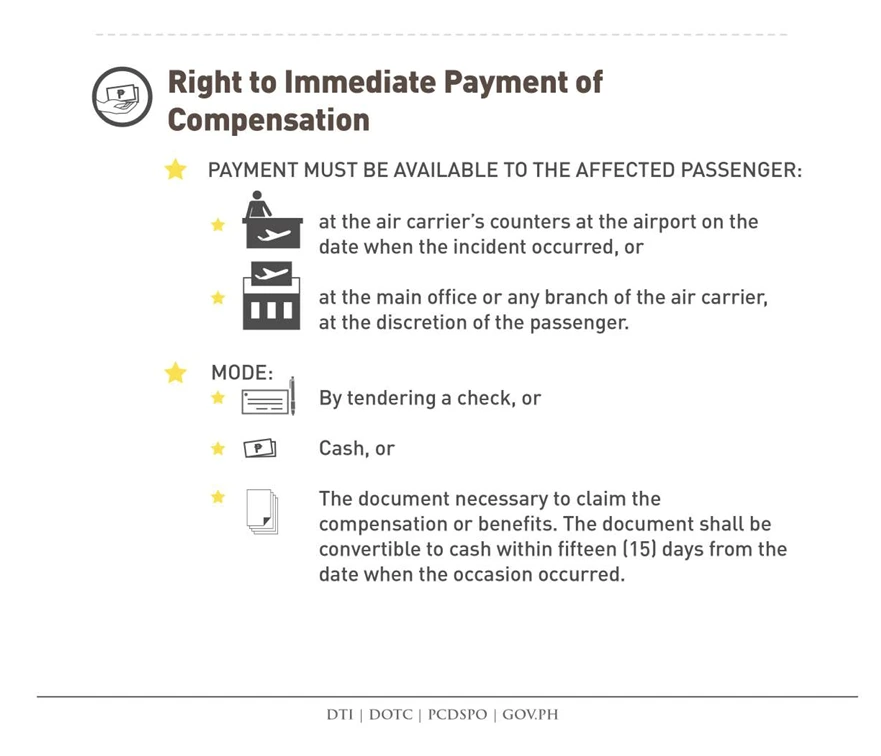
Unless otherwise agreed, refunds should be made in the original currency used to buy the tickets from the air carrier or from third-party providers.
There you have it. Know your rights whenever you travel by air and make sure to bookmark this article for reference. Read the full Air Passenger Bill of Rights here.