Motorcycle usage in the Philippines continues to increase. Not only do motorcycles offer more convenient and economical transport to Filipinos, but in many cases, they are the most direct option for commuters given the mess that is Manila’s public transportation system.
Data from the Land Transportation Office (LTO) shows that there are around 19.2 million motorcycles in the country, making up roughly 87% of all registered motor vehicles as of 2022. In fact, one out of three Filipino households owns a motorcycle.
It’s no surprise that many motorcycle riders bring other passengers aboard as backriders for errands and essential transport. However, this can pose significant risks when the passengers are small children.
To ensure the safety of child passengers on motorcycles, clear guidelines were set through An Act Providing for the Safety of Children aboard Motorcycles signed back in 2015 and came into effect two years later. But despite the law’s existence for the past few years, not all motorcycle riders are aware of the specific rules and regulations.
In case you’re a new motorcycle driver with small kids at home or you’re unsure what exactly is allowed and not allowed, here’s our detailed explainer to help refresh your memory.
ALSO READ:
How to avoid traffic: Guide to motorcycle taxi services in the Philippines
Riders, here’s a full guide on the motorcycle dress code in PH
What is the Children’s Safety on Motorcycles Act?
Republic Act No. 10666, also known as the Children’s Safety on Motorcycles Act of 2015, strictly prohibits “any person to drive a two-wheeled motorcycle with a child on board on public roads where there is a heavy volume of vehicles.” It also prohibits driving on roads with a high density of many fast-moving vehicles or where a speed limit of more than 60kph is imposed.
Under the law, sitting in front of the driver is not allowed as well. The regulations apply to public roads and highways nationwide
When did the law come into effect?
President Benigno Aquino signed the law on July 21, 2015, but the full implementation officially took effect on May 19, 2017. This came after deferments following the drafting of implementing rules and regulations which involved public consultation with various stakeholders over the years.
Is everyone under 18 years old covered by the law? When can children ride as motorcycle passengers?
While the law defines children as any person below 18 years old, the prohibitions apply mostly to babies, toddlers, and smaller children who do not meet the height and physical requirements to ride a motorcycle safely. Older children and teens are allowed to ride as pillion passengers as long as certain conditions are met.
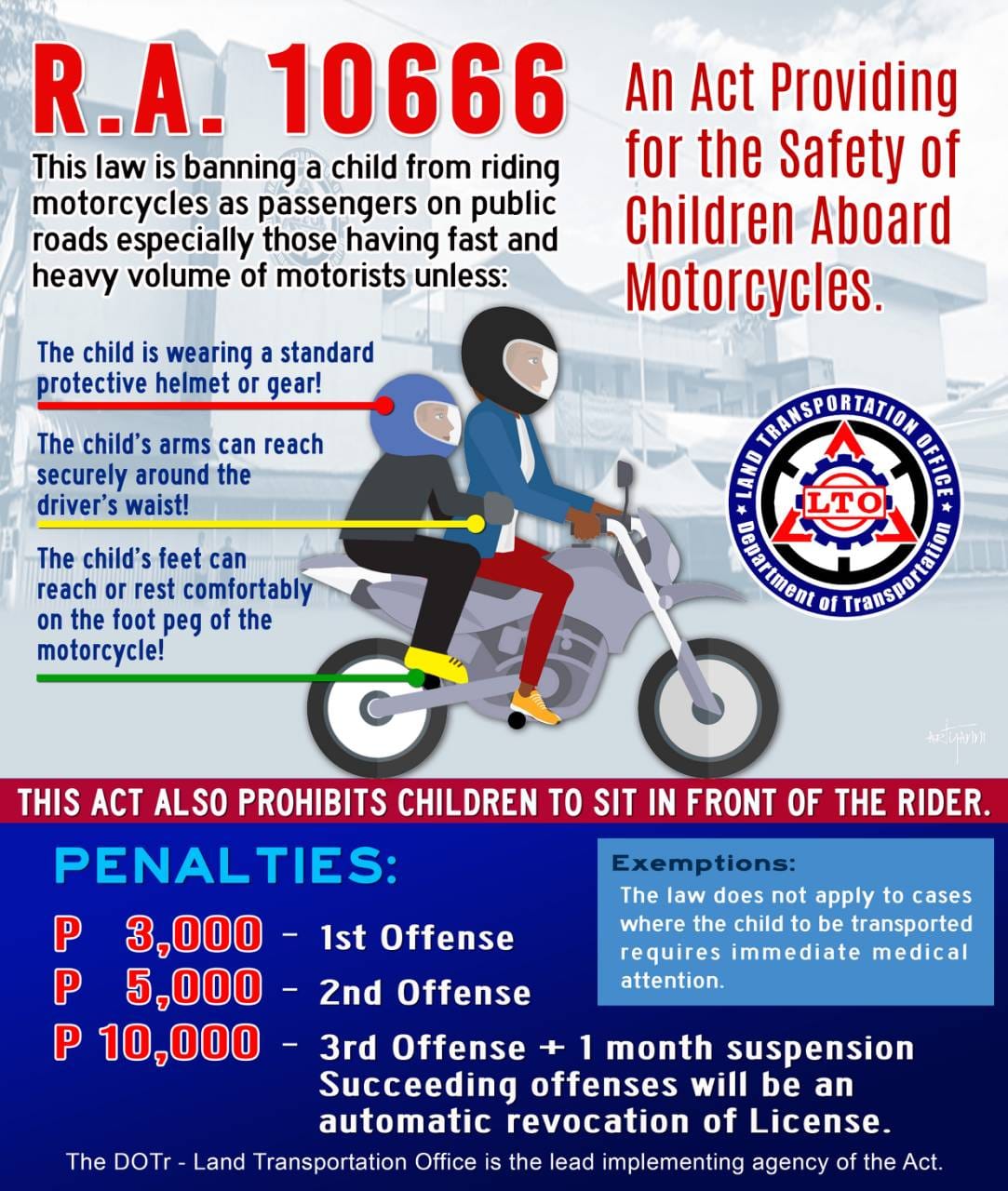
Children are allowed as back riders if they can comfortably reach his/her feet on the standard footpegs of the motorcycle. A child’s arms also need to be able to reach around and grasp the waist of the motorcycle driver.
Children should also be wearing a standard protective helmet referred to under Republic Act No. 10054, otherwise known as the “Motorcycle Helmet Act of 2009.”
In case a child doesn’t meet the height requirements, one clear exemption can be made when the child requires immediate medical attention and must be transported right away.
What are the fines and penalties for disregarding the law?
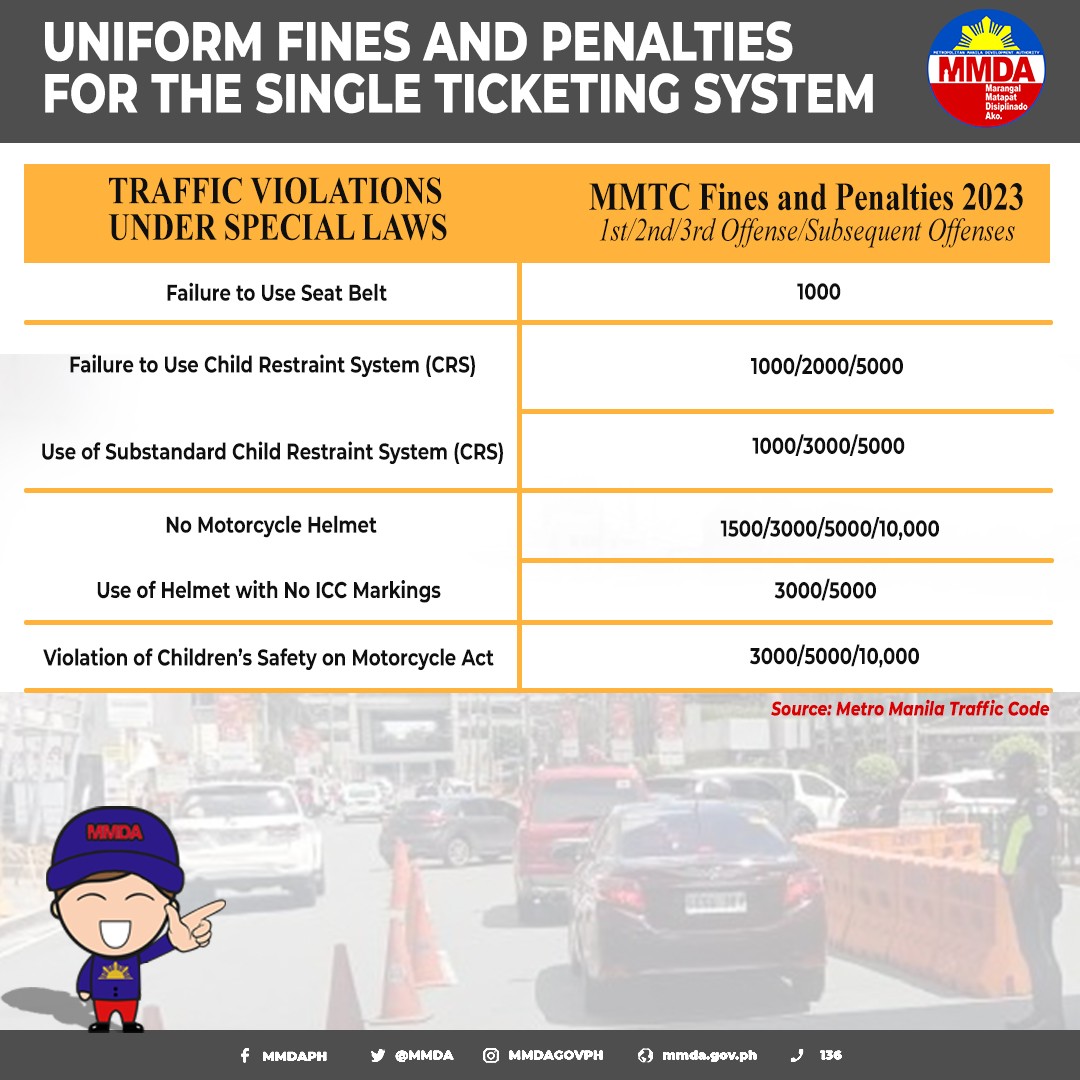
Any individual found driving with a child on a busy street without appropriate protection will be subjected to corresponding fines. Violators of RA 10666 face a fine of P3,000 for the first offense, P5,000 for the second offense, and P10,000 plus a one-month suspension of the driver’s license suspension for the third offense.
Succeeding violations will result in a P10,000 fine and immediate cancellation of the driver’s license. The fines and penalties for traffic violations under special laws are now uniform across all cities under the Metro Manila Traffic Code of 2023 or Single Ticketing System.
What happens in case a child gets injured while in violation of the law?
Another provision under the Children’s Safety on Motorcycles Act points to qualifying circumstances and harsher penalties for incidents resulting in serious injuries or death of child passengers aboard motorcycles.
Section 8 of the law states that “If, in violation of the provisions of this Act, death shall have resulted or serious or less serious injuries shall have been inflicted upon the child or any other person, a penalty of one (1) year imprisonment shall be imposed upon the motorcycle rider or operator of the motorcycle involved without prejudice to the penalties provided under Act No. 3815, otherwise known as “The Revised Penal Code of the Philippines”, as amended.”
Therefore, if a child passenger is injured or dies following a violation of RA 10666, the driver will have to serve jail time.
ALSO READ:
Flying out? Here’s an updated transport guide to and from NAIA
Transport guide: Easiest ways to get to and from Clark International Airport
Who is allowed to apprehend erring motorists?
While the Land Transportation Office (LTO) is the lead implementing agency, they may deputize traffic officers of the Philippine National Police (PNP), Metropolitan Manila Development Authority (MMDA) as well as entities of local government units to ensure that motorcycle riders do not neglect children’s safety.
Why is the law important?
According to the 2018 Global Status Report for Road Safety of the World Health Organization (WHO), nearly 30 percent of all road crash deaths involve powered two- and three-wheeled vehicles, such as motorcycles, mopeds, scooters, and electrical bikes (e-bikes).
The report also noted that motorcyclists are more vulnerable to sustaining head and neck injuries because of their lack of physical protection while weaving in and out of traffic with fast-moving cars and buses.
Road traffic injuries continue to claim the lives of an average of 600 children below the age of 15, according to estimates of the Philippine Statistics Authority in their 2016 Report.
Last May 2023, the Land Transportation Office (LTO) reported that 1,737 motorists were apprehended in Metro Manila for various traffic violations, including violations of RA 10054 or failure to wear a motorcycle helmet and RA 10666 or the Children’s Safety on Motorcycles Act.
Incidents caught on social media illustrate some of the dangers that children face while riding motorcycles unprotected. One viral video of a motorcycle rider with a toddler positioned behind the rider with no helmet earned the ire of netizens during the law’s early first year of implementation.
Earlier this year, the LTO suspended the driver’s license of a motorcycle rider who was caught on video transporting a child inside a delivery box.
The penalties under the law are not meant to make the lives of motorcycle commuters harder than they already are but are meant to protect children, who are more vulnerable than adults on the road. At the end of the day, driving a vehicle is a privilege. Drivers must adhere to the laws and ensure the safety of all passengers, particularly children.