The lack of convenient public transport systems around Metro Manila is only encouraging more people to turn to private cars and motorcycles for mobility in the city. With return-to-office orders and the resumption of events around the metro, residents need to find ways to get around conveniently.
However, before you can start driving around, you’ll first need to acquire a valid driver’s license.
A driver’s license is an official, government-issued identification card that authorizes the cardholder to drive a motor vehicle in the Philippines. Licenses are issued by the Land Transportation Office (LTO), a government agency under the Department of Transportation (DOTr).
ALSO READ:
What you need to know about electronic driver’s licenses
How to create an LTO LTMS account for driver’s license renewal
In recent years, the LTO has overhauled different systems in relation to driver’s licenses. Along with extending the validity and streamlining requirements, they also shifted to using new driver’s license codes with detailed subcategories to indicate exactly what type of vehicles a license holder can operate.
In case you’re planning to apply for a driver’s license for the first time or need to get your license renewed soon, here’s what you need to know about LTO-issued driver’s licenses as of July 2023.
Parts of a Driver’s License
Both professional and non-professional driver’s licenses issued in the Philippines have two faces. The front contains the picture of the driver and information including name, nationality, sex, date of birth, weight, height, home address, license number, expiration date, blood type, eye color, conditions, and restrictions.
The front also contains the signature of the driver and assistant secretary. Safety features can also be found, including a holographic seal of the LTO superimposed on the ID photo.
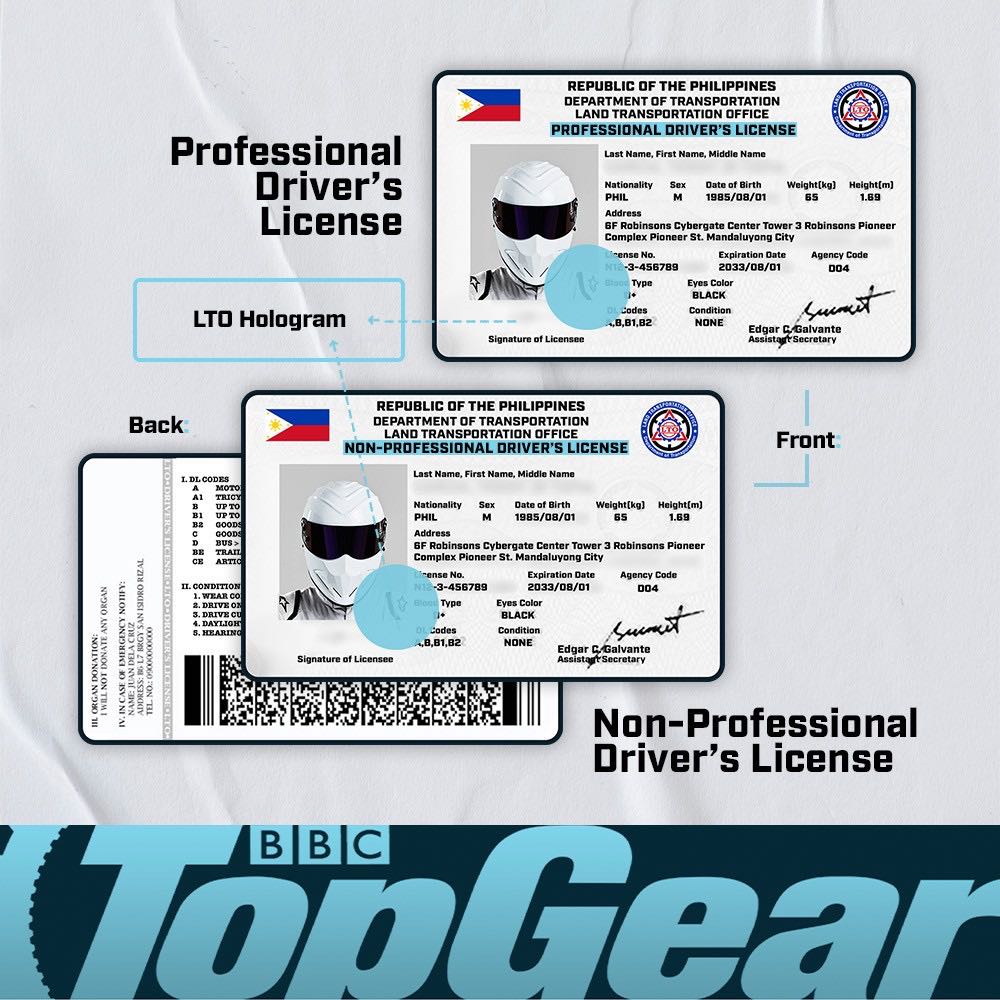
The back of the license contains a legend of restriction codes, conditions, the serial number, an indication if you are an organ donor, and who to contact in case of emergencies. At the back, you can also find a barcode that can be scanned for identification, a small black-and-white image of your ID photo, a serial number, and security tape.
The new driver’s license models also list the actual DL Codes, vehicle categories, classification, and type of transmission of the license holder, which we’ll explain further below.
What do the restriction and condition codes mean?
Before applying for a driver’s license or getting one renewed, you’ll need to know the proper LTO restriction and condition codes in order to drive different motor vehicles. During your application process, make sure that you are applying for the right restrictions and indicate any disabilties that may require special conditions for driving.
Old restriction codes
Under the old restriction code system, which are still visible in many models of driver’s licenses issued since August 2017, the eight restrictions are listed numerically as follows:
- Restrictions:
1. Motorcycles/Motorized Tricycles
2. Vehicles up to 4,500kg in gross vehicle weight
3. Vehicles above 4,500kg in gross vehicle weight
4. Automatic clutch up to 4,500kg in gross vehicle weight
5. Automatic clutch above 4,500kg in gross vehicle weight
6. Articulated vehicle 1,600kg gross vehicle weight and below
7. Articulated vehicle 1,601kg up to 4,500kg gross vehicle weight
8. Articulated vehicle 4,501kg and above in gross vehicle weight
License holders can have multiple restriction codes listed on the front. Those with restriction codes 1, and 2 can drive both a motorcycle or a car that is 4,500kg and below. However, you can not drive a vehicle whose restriction code does not appear on your license. For instance, those who don’t have restriction code 1 listed can not be allowed to drive motorcycles.
Meanwhile, the conditions refer to special equipment and scenarios needed for license holders to drive the said motor vehicles. The five conditions, denoted by letters A to E, take into account those with sensory and physical disabilities and special needs.
- Conditions:
A. Wear corrective lenses
B. Drive only with special equipment for upper limbs
C. Drive only with special equipment for lower limbs
D. Daylight driving only
E. Accompanied by a person with normal hearing
New restriction codes
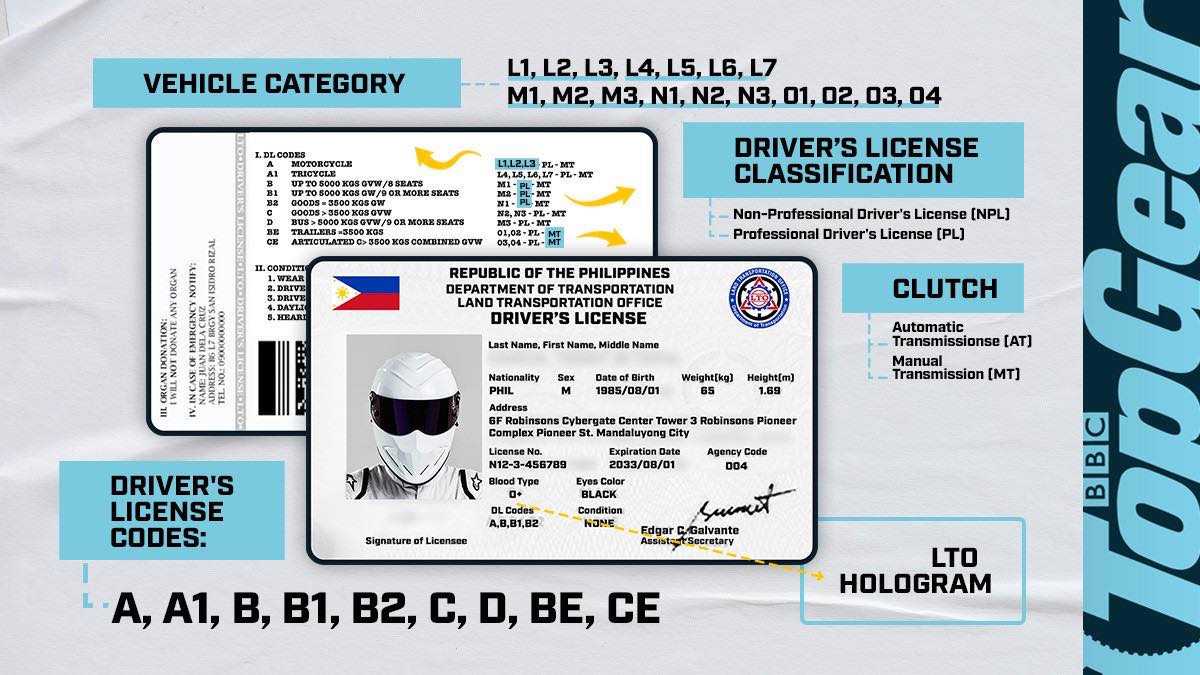
In 2021, the LTO revised the format and started using alphanumeric DL Codes for the restrictions. There are now nine DL codes, running from A to CE, which represent the general types of vehicles one can operate. The restriction codes for also contain more detailed information on the type of vehicles, subcategories, and transmission type of vehicles.
The new format includes the Driver’s License Codes (A, A1, B, B1, etc.), Vehicle Categories (L1, M1, N1, etc.), Driver’s License Classification (PL/NPL), and type of Clutch (AT, MT) used.
I. Driver’s license codes
A. Motorcycle
A1. Tricycle
B. Up to 5,000kg gross vehicle weight/8 seats
B1. Up to 5,000kg gross vehicle weight/9 or more seats
B2. Goods less than or equal to 3,500kg gross vehicle weight
C. Goods greater than 3,500kg gross vehicle weight
D. Bus greater than 5000kg gross vehicle weight/9 or more seats
BE. Trailers less than or equal to 3,500 kg
CE. Articulated goods greater than 3,500kg combined gross vehicle weight.
Vehicle category
Motorcycle
- L1 – two wheels with a maximum design speed not exceeding 50kph
- L2 – three wheels with a maximum design speed not exceeding 50kph
- L3 – two wheels with a maximum design speed exceeding 50kph
Tricycles, quadricycle, etc.
- L4 – motorcycle with sidecars with a maximum design speed exceeding 50kph
- L5 – three wheels symmetrically arranged with a maximum speed exceeding 50kph
- L6 – four wheels whose unladen mass is not more than 350kg with maximum design speed not exceeding 45kph
- L7 – four wheels whose unladen mass is not more than 550kg with maximum design speed not exceeding 45kph
Cars, trucks, buses, and trailers
- M1 – vehicles that go up to 5,000kg gross vehicle weight with not more than 8 passenger seats
- M2 – vehicles up to 5,000kg gross vehicle weight with more than 8 passenger seats
- M3 – Vehicles above 5,000kg gross vehicle weight with more than 8 passenger seats
- N1 – vehicles up to 3,500kg gross vehicle weight for carriage of goods
- N2 – vehicles exceeding 3,500kg gross vehicle weight for the carriage of goods
- N3 – vehicles exceeding 3,500kg gross vehicle weight for the carriage of goods
- 01 – Articulated vehicle in either manual or automatic vehicle not more than 750kg gross vehicle weight
- 02 – Articulated manual or automatic vehicle exceeding 750 up to 3,500kg gross vehicle weight
- 03 – Articulated vehicle manual or automatic exceeding 3,500kg gross vehicle weight
- 04 – Articulated vehicle manual or automatic exceeding 3,500kg gross vehicle weight
Driver’s license classification
- NPL – Non-professional driver’s license
- PL – Professional driver’s license
Clutch restriction code
- AT – automatic transmission
- MT – manual transmission
II. Conditions
The new condition codes still indicate sensory or physical aids for differently-abled drivers to operate motorized vehicles with a few tweaks from the conditions in the old system. Aside from changing from letters to numbers, this includes the addition of use of customized motor vehicle and use of hearing aids instead of having to be accompanied by a person with normal hearing.
- Wear corrective lenses
- Drive only with special equipment for upper/lower limbs
- Drive customized motor vehicle only
- Daylight driving only
- Hearing aid required
Restriction codes and their equivalent DL Codes
Upon renewing your licesnse, the old restriction codes will be converted into the new restriction codes by the LTO. Applicants need to dictate what kind of code to get, and then apply for the specific code.
For instance if you can drive both a motorcycle and passenger car, your restriction codes will change from 1, 2 to A, B in the new models, with specific subcategories.
How to read the new DL Codes in your license
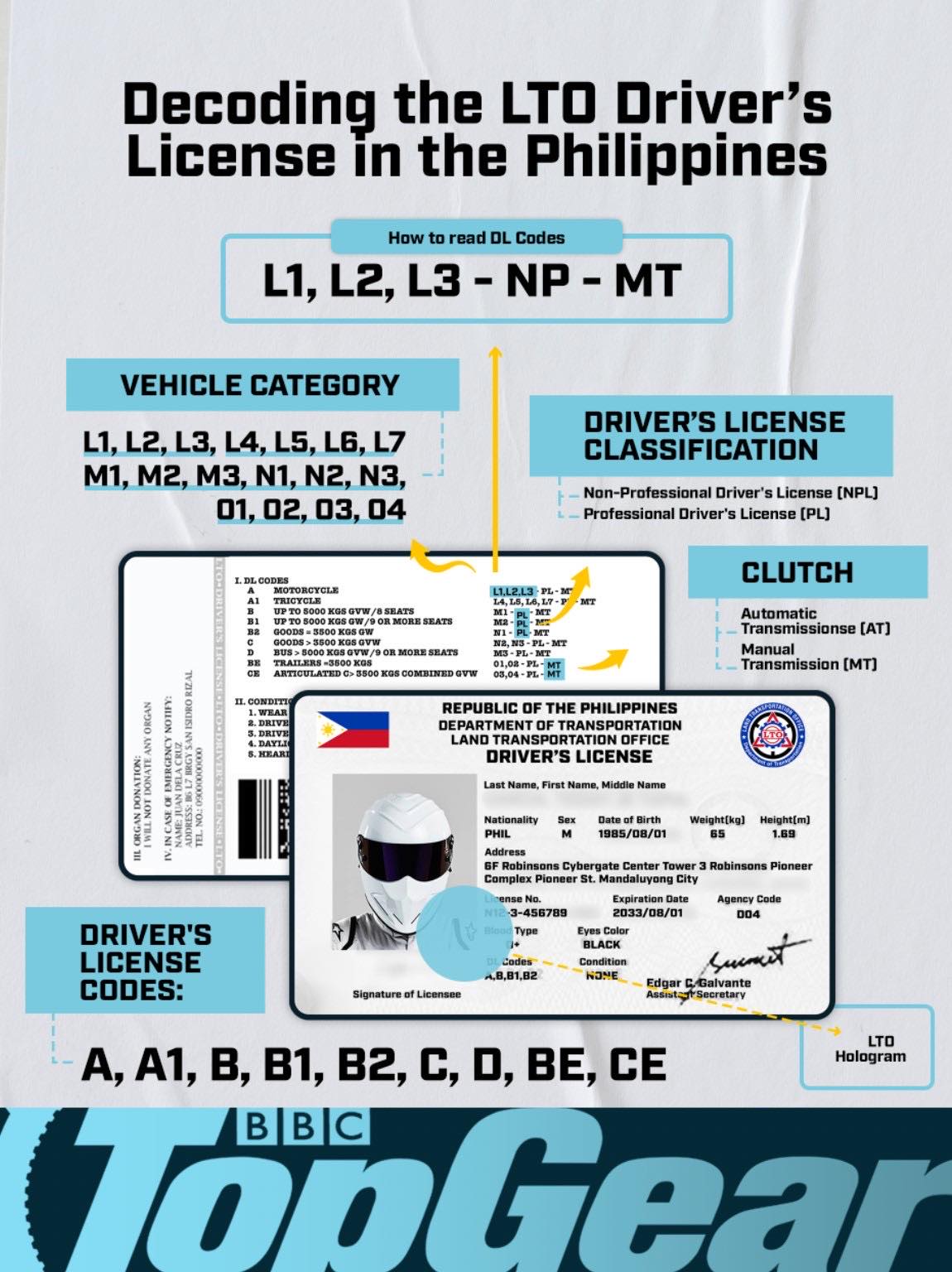
According to LTO, the first set of alphanumeric codes indicates the vehicle categories you can operate. The second set of codes refers to the license classification. “PL” refers to a professional license, while “NP” means non-professional license. The last set of codes indicates the transmission type or clutch. “MT” refers to a manual transmission, while “AT” refers to automatic transmission.
If the restriction indicates “MT,” you can operate both manual and automatic transmissions. However, if your restriction is set to “AT,” you may only drive automatic transmissions.
If you have an automatic motorcycle and a standard automatic light passenger car (8 seats or less) for personal use, your DL code would look something like:
- A: L1, L2, L3-NP-AT
- B: M1, M2, N1-NP-AT
If you’re driving a light truck for transporting of goods (4-wheels) with manual transmission only, your DL code should be as follows:
- B2: N1-PL-MT
If you’re hearing impaired, but can drive both automatic light passenger cars AND manual motorcycles for personal use, your DL code would be:
- A: L1,L2,L3-NP-MT, 5
- B: M1,M2,N1-NP-MT, 5
Recent controversies
The LTO has had its fair share of problems that have affected the actual delivery of driver’s licenses among the Filipino driving public. From disagreements within the different transportation offices, resignations from agency chiefs, and procurement-related issues leading to a backlog in printing driver’s licenses, the LTO has been making headlines.
In April this year, the LTO had to start issuing temporary driver’s licenses on paper because of the nationwide plastic shortage. At the time, it extended the validity of driver’s licenses expiring April 24 onwards to October 31, 2023, without penalties for late renewal.
Senator Raffy Tulfo filed Senate Resolution (SR) 577 to investigate the bidding process of the plastic cards for licenses while slamming the “anti-poor” process of obtaining driver’s licenses, due to expensive requirements including the Theoretical Driving Course and Practical Driving Course with an LTO-accredited driving school and costly medical exam to obtain a medical certificate from an LTO-accredited clinic.
Starting July 26, the LTO will be rolling out digital driver’s licenses as a replacement for the paper receipts issued by the LTO upon issuance or renewal.