Picture this: You’re driving along peacefully when a speeding SUV overtakes you and crashes into a delivery rider only to speed away, leaving the rider unconscious on the ground. Or you’re going home late at night passing a remote road when you see a car crashed into a tree, with the driver knocked out, and no one else in sight.
Sadly, road accidents are a common daily occurrence in the Philippines.
According to the Philippine Statistics Authority (PSA), road accidents make up the highest non-disease cause of death in the Philippines. The Department of Transportation (DOTr) noted that in 2022, more than 11,000 individuals died due to road accidents.
That’s 31 deaths and injuries per day from road crashes, mostly among vulnerable road users including motorcyclists, cyclists, and pedestrians.
The rainy season also brings a host of problems to the driving public. Frequent downpours come with terrible traffic, decreased visibility, and flooded roads, which can lead to an increase in road accidents.
ALSO READ:
Quick guide: How to wear a seatbelt properly
All you need to know about the Child Car Seat Law in PH
Duty of the driver in a road accident
Generally, it is the responsibility of the driver of a motor vehicle involved in an accident to aid victims as detailed under Republic Act No. 4136 or the Land Transportation and Traffic Code.
Specifically, the duty of the driver should they be involved in an accident is covered under Chapter IV, Article V, Section 55, as follows:
In the event that any accident should occur as a result of the operation of a motor vehicle upon a highway, the driver present, shall show his driver’s license, give his true name and address and also the true name and address of the owner of the motor vehicle.
No driver of a motor vehicle concerned in a vehicular accident shall leave the scene of the accident without aiding the victim, except under any of the following circumstances:
- If he is in imminent danger of being seriously harmed by any person or persons by reason of the accident;
- If he reports the accident to the nearest officer of the law; or
- If he has to summon a physician or nurse to aid the victim.
The Metropolitan Manila Development Authority (MMDA) has issued updated general guidelines on what to do during vehicular accidents. Those involved in minor and major accidents should:
- Check if anyone is hurt.
- Make sure to take pictures of the accident.
- Move your vehicle to the side of the road if possible.
- Let the investigator take command of the situation, and institute measures to prevent the accident from getting worse.
- Exchange information with the other driver.
- Contact your insurance company and know what your policy covers.
- File an accident report with the police department.
But what exactly should you do if you happen to just witness an accident without being directly involved?
Legally, it is not the responsibility of eyewitnesses or third parties to stop or help parties involved in road accidents. However, for common decency and humanity’s sake, sometimes we feel a sense of duty to help fellow motorists, especially when those involved can’t take action themselves, such as in cases of hit-and-run incidents, or if both parties are unconscious.
Prioritize safety
According to MMDA guidelines, the principal concern during road accidents is the safety and well-being of everyone involved. In case those directly involved can’t take action themselves, other passengers, eyewitnesses, and drivers around the scene can provide assistance to victims.
You can use your own vehicle as a warning device to help protect victims on the scene if there’s a possibility of victims getting run over again or if the accident could worsen and result in a pile-up. Stop safely before the scene of the accident and turn on hazard lights to notify oncoming vehicles. Those who have early warning devices (EWD) in their cars’ trunks can set up a perimeter around the incident.
If the victim is conscious and able to walk to the side of the highway, you can park your vehicle to the side and turn the hazard lights on to assist them or block other vehicles so injured parties can cross safely.
However, the MMDA advises third parties to be mindful of traffic while providing assistance. Onlookers should not take up multiple lanes or block the roads, so emergency responders can get to the scene faster.
Call emergency hotlines
While it is not the responsibility of witnesses to call for help, it could potentially save someone’s life.
If someone is too hurt or unable to make the calls themselves, witnesses can call for medical assistance. Dial the MMDA Hotline 136 or National Emergency Hotline 911 and ask for a medical team or traffic investigator to go to the scene.
When you do call, try your best to explain the situation clearly, give an exact location of the incident, and indicate at once what kind of help is needed.
Provide critical help only if you can
It’s always best to let trained officials, including police and medical professionals take charge of the situation during accidents.
But in cases when immediate help is needed, those who are formally trained in first aid or have experience in the medical field, military or law enforcement with medic training can step in as first responders.
However, those who are not trained should not try to administer first aid or move people from vehicles, as they may inadvertently harm the victims further. Despite having good intentions and just wanting to help, potential legal liabilities may arise in case you try to help without proper training.
Citizen responders can still provide critical help in other ways, by reporting the incident, providing water to dazed victims, helping riders gather their things scattered on the road after a crash, or simply showing support and keeping victims calm before officials arrive on the scene.
Take pictures of the road accident
To help out victims, take pictures or video clips for evidence. Photos showing the vehicles and the surrounding area can help establish the cause of accidents in case other parties denied what happened. Make sure to take pictures of both vehicles including license plates, and a wide shot of the area where the accident occurred.
Take note that these photos should be used for reporting purposes and to hopefully establish the cause of the accident. Posting graphic pictures of accidents on social media just to garner reactions and get viral engagement even before reporting the incident is not the right thing to do. Bear in mind the reaction of the victim’s family if they come across the photos online.
Report the incident
In case you were able to capture the accident itself on a dashcam, this could also help establish objective evidence of the circumstances leading to the accident.
In case you get asked to share a narrative of the scene as a witness for police records, pay attention to important details such as the description of each vehicle, including the make, model, and color.
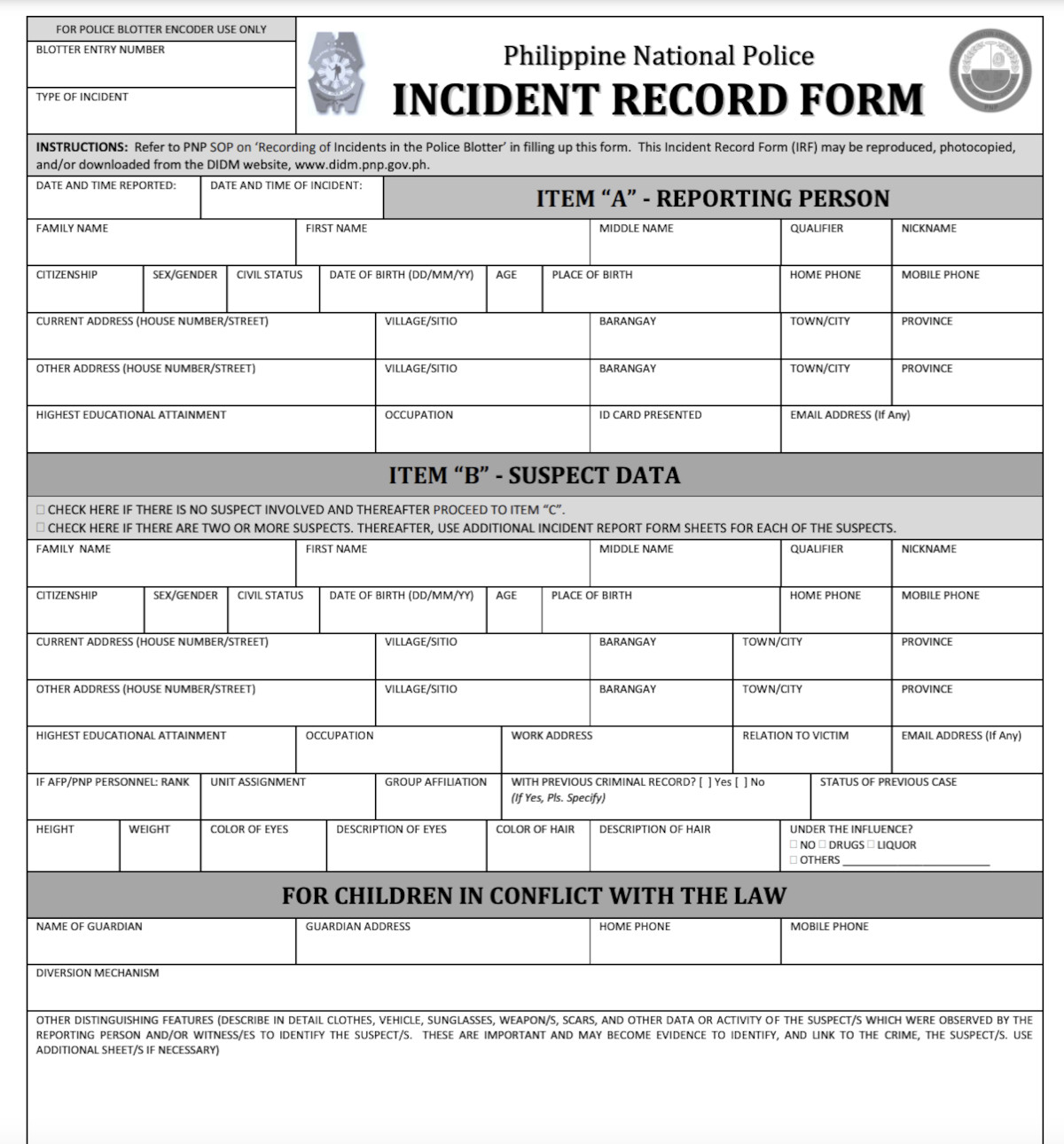
Based on PNP Incident Record Forms and their SOP procedure for their Incident Recording System, important details to note include the type of incident, time and date of incident, place of incident, and narrative of the incident, as well as answering the who, what, when, where, and how of reporting.
If you’re not in a position to stay around the scene but still want to help, you can also report incidents to LTO via the ‘INFORM-CER’ (a combination of the words informer and enforcer) program launched in October 2021. Road crashes are included in the types of incidents you can report, along with other traffic violations like poorly maintained vehicles, reckless driving, and smoke belching vehicles, and minor infractions.
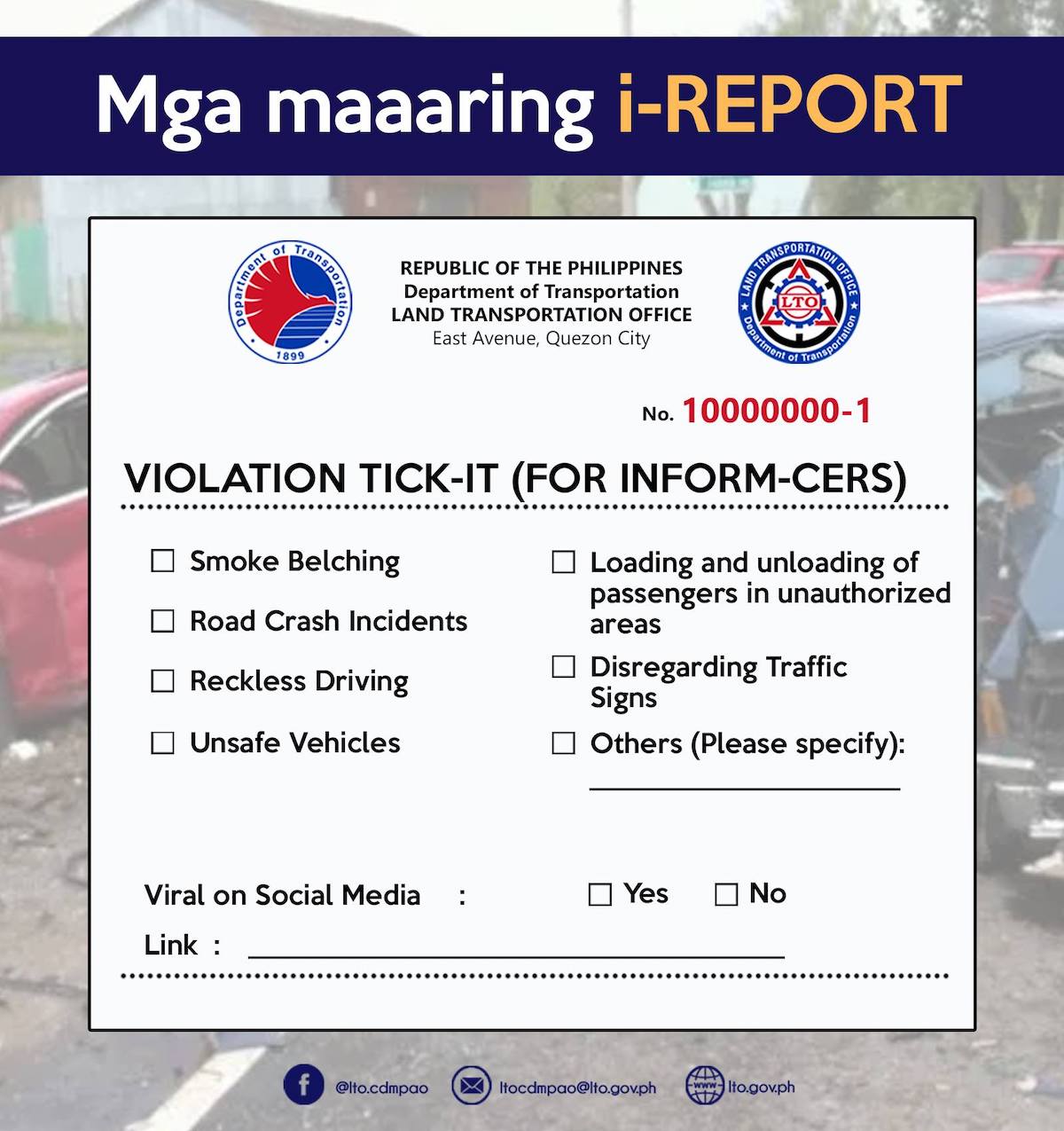
Take note of the following details for the incident report:
- A short description of what happened
- Details of the vehicle(s)
- Plate number
- Make/Model
- Color
- Location
- Time and date
- Photo or video footage (if the content has gone viral, you can provide the link)
Incidents can be reported to LTO’s Digital Media Public Assistance Office through any of the LTO’s official social media pages, including those of regional offices concerned. You can also send reports by email to ltocdmpao@lto.gov.ph.
Take note of emergency numbers
Even if you are not directly involved in a road accident, it’s natural to get scared, freeze, hesitate to help, or not know what to do just while witnessing one. For major road accidents that require quick action, try and stay calm and know what numbers to call.
Here are a few hotlines and numbers that could help motorists in case of emergencies and road accidents.
- MMDA
- Hotline: 136
- Trunk line: (+632) 8882-4151 to 77
- Local 337: Rescue
- Local 1096: Metrobase
- Local 1135: Road Safety
- Local 1168: Public Safety
- Local 1169: Road Emergency
- Local 1162/1163: Flood Control
- Viber: (+63939) 922-7161
- National Emergency Hotline: 911
- Philippine National Police Hotline: 117 / (+632) 8722-0650
- Philippine Red Cross: 143 / (+632) 8527-8385
- Bureau of Fire Protection: (+632) 8426-0219 / (+632) 8426-3812
- North Luzon Expressway (NLEX): 1-35000
- Subic-Clark-Tarlac Expressway: 1-35000
- Tarlac–Pangasinan–La Union Expressway (TPLEX): (+63917) 888-0715
- South Luzon Expressway (SLEX): (+63917) 687-7539 / (+6349) 508-7539
- Skyway: (+63917) 539-8762 / (+632) 5318-8655
- Muntinlupa-Cavite Expressway (MCX): (+632) 7795-1629
- STAR Tollway: (+63917) 511-7827 / (+6343) 756-7870
- Manila-Cavite Expressway (CAVITEX): 1-35000
- Cavite-Laguna Expressway (CALAX): 1-35000
- C5 Link Expressway: 1-35000
- Cebu–Cordova Link Expressway (CCLEX): 1-35000