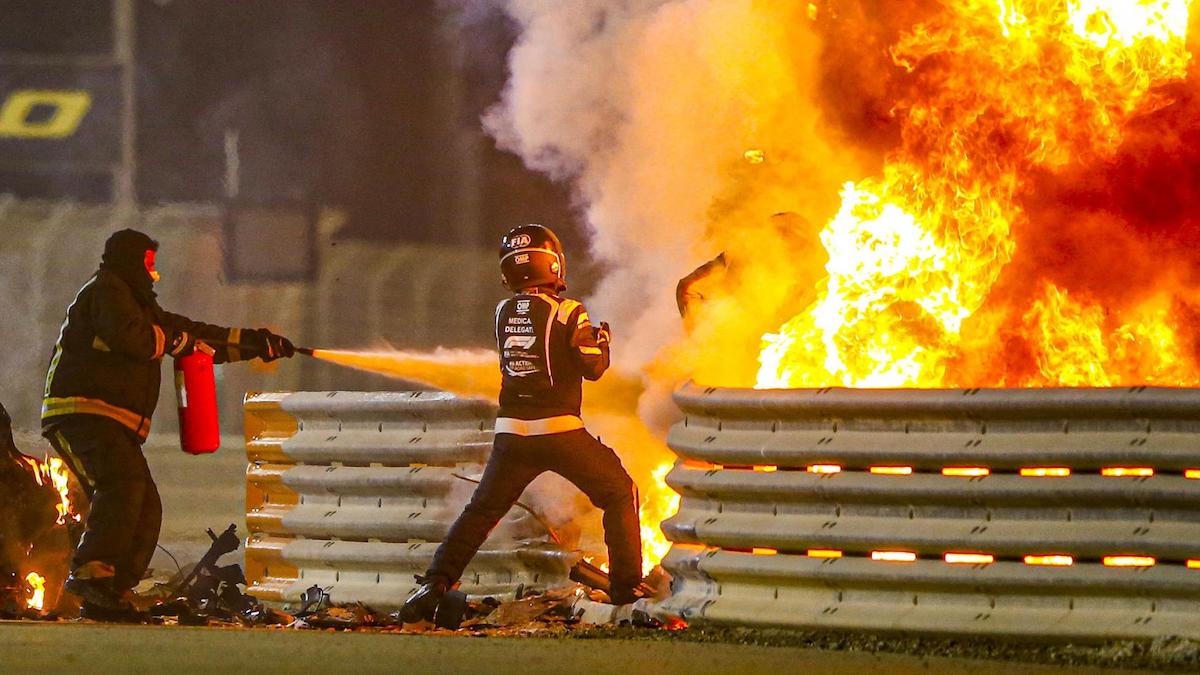
The 2020 Bahrain GP saw one of Formula 1’s fieriest crashes in recent history. Having collided with the AlphaTauri of Daniil Kyvat, Romain Grosjean’s Haas race car speared uncontrollably off the track on the opening lap, and impacted a metal barrier at 220kph.
Watch the footage below:
Here are five factors that saved the Frenchman’s life in this accident.
1) The HANS device
On-board data readings have suggested the impact force was some 51g, yet Grosjean remained conscious and was able to set about undoing his harness, removing the cockpit head restraint, and jumping from the burning wreckage.
The HANS or ‘head and neck support’ device will have helped protect him from head and neck injuries during this violent deceleration. It’s the strapped carbon contraption you see attached to the rear of an F1 driver’s crash helmet, which is secured by the harness and prevents strong whiplash injuries in a crash. It’s been a mandatory safety feature in F1 since 2003.
2) The halo
“I wasn’t for the halo some years ago, but I think it’s the greatest thing that we’ve brought to Formula 1, and without it, I wouldn’t be able to speak with you today.”
Those were the sobering words of Grosjean himself from his hospital bed in the aftermath of his crash. When the nose of his car pierced the unpadded metal barrier, the titanium halo cockpit surround parted the sections of Armco as the Haas penetrated through the structure. Had the ultra-strong halo not been present, multiple F1 experts have suggested that Grosjean’s helmet would have interfaced with the barrier itself, which would likely have led to much more serious injuries.
Though the halo was scarred by the impact and the ensuing inferno, it remained structurally sound throughout the incident.
3) The safety cell
What made Grosjean’s accident particularly horrifying was the manner in which the car split in two after the impact. We’re used to seeing fluttering shards of carbon fiber flying from an F1 car’s various wings and aero devices in a collision, but it’s extremely rare to see the car fail structurally.
In this case, the front section of the Haas pierced the barrier at an angle, with the crash forces tearing off the rear end of the car, complete with the heavy engine and hybrid batteries. However, while the fuel system was punctured, the driver’s hugely rigid carbon-fiber cockpit, known as the safety cell, remained intact and unobstructed. This meant Grosjean was given the best possible chance of an exit path from his stricken car, rather than being trapped in the fire.
4) Better fireproof clothing
Footage of the accident showed that Grosjean freed himself from the burning car approximately 18sec after impact. According to ex-F1 driver and commentator Karun Chandhok, the FIA has only this year upgraded the fireproof overalls worn by the drivers, increasing their fire-resistant time from 10sec to 20sec.
The drivers’ gloves, however, are of the previous 10sec-flameproof design, which may explain why Grosjean’s only injuries were second-degree burns to the backs of his hands.
5) Medical and marshal response time
The Mercedes-AMG C63 wagon that follows the F1 cars around the first lap is driven by racing driver Alan van der Merwe and crewed by F1’s deputy medical delegate Dr. Ian Roberts. While the 503hp C63 is a fast car, it’s obviously left trailing by 1,000hp F1 monsters. Had the crash occurred later in the lap, medical help would have taken longer to arrive.
However, Merwe halted the medical car next to the crash scene just 10sec after it occurred, while marshals arrived with fire extinguishers to suppress the flames just enough to help Grosjean escape. Meanwhile, Dr. Roberts braved the intense heat to help the shaken Frenchman over the destroyed barrier and away to safety.
Van der Merwe said: “It was a big surprise for us as well—we’ve never seen that much fire in 12 years. Romain started to get out of the car himself, which was pretty amazing after an accident like that. It was a relief to see he was okay.”
Dr. Roberts told Sky Sports: “There was just a massive flame, and as we arrived, it was a very odd scene. We’d got half the car pointing in the wrong direction and then just across the barrier, a mass of heat.
“We needed some way of getting to him, and we had the marshal there with an extinguisher, and the extinguisher was just enough to get the flame away. Romain then got high enough for me to reach over and pull him over the barrier.
“Obviously, he was very shaky. His visor was completely opaque and in fact, melted. I had to get his helmet off just to check that everything else was okay.”
NOTE: This article first appeared on TopGear.com. Minor edits have been made.