Sharp is best known for its home appliances. Whether it’s refrigerators, televisions, or washing machines, the Japanese company has something for, well, just about everyone.
Now, the electronics giant is dipping its toes in the automotive scene. It’s a concept for now, but it does show that the company has an interest in building vehicles.
OTHER STORIES YOU MIGHT HAVE MISSED:
PH fuel price update: P1.55/L rollback for gas, P1.30/L for diesel effective September 10
DPWH: Kennon Road not passable to all vehicles due to erosion

Sharp’s concept is called the LDK+. It’s an electric minivan developed in collaboration with Foxconn. In terms of design, it’s well, a van, and there isn’t much one can do with a one-box design. It has a cab-forward look that maximizes interior space, and a flat rear tailgate for extra volume. The LDK+ also has a large solar panel on the roof to keep its batteries charged while on the go.
The main highlight here is the tech used in the van. The LDK+ uses Sharp’s propriety artificial intelligence (AI) technology, CE-LLM. Its AI allows for further personalization, as well as bridging the gap between home and vehicle by connecting the van’s network to the owner’s house and vice versa.

With an emphasis on ‘living space’, the van’s interior wouldn’t look out of place in a studio-type condominium. The second-row seats swivel backward and doubles as a couch for the ‘living room’. There’s a modular table that springs from the rear, along with a whopping 65-inch screen for the full home theater experience.
There are more tricks inside, too. That same screen can even be used for video calls. The rear section can also be used as a mobile office or children’s play area. When the door closes, the liquid crystal shutters on both side windows close, creating a private space.
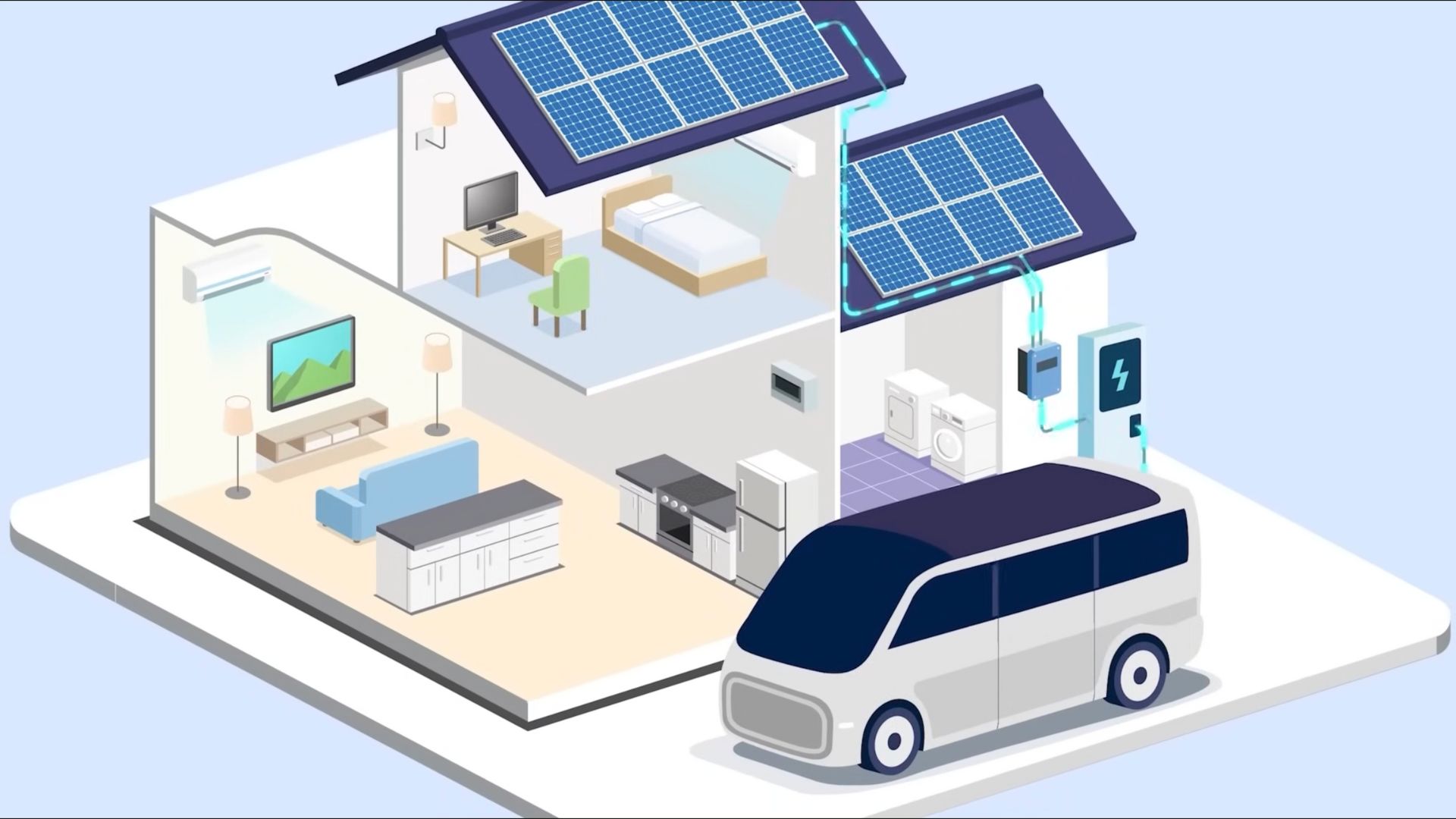
The solar panels attached to the roof aren’t just there to charge up the vehicle’s batteries. The LDK+ itself can serve as a power source for the household for optimal energy management for both home and vehicle. As the van powers the house, the solar panels keep it topped up, allowing for continuous energy supply.