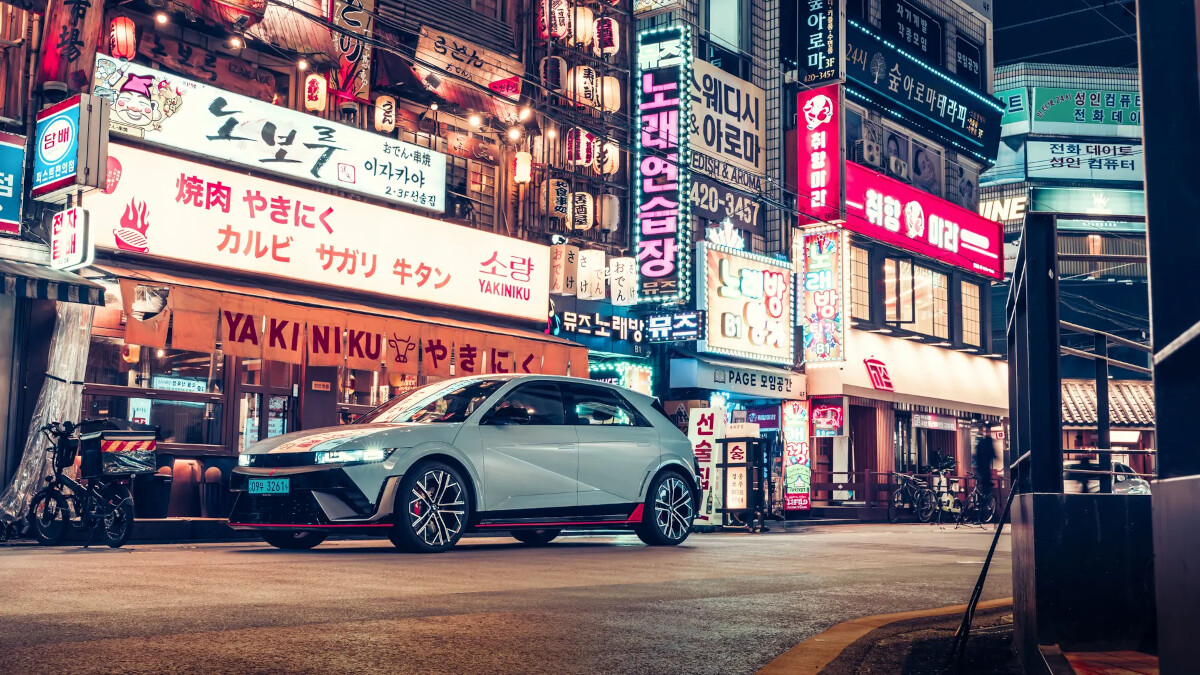
Several Hyundai engineers tell me they were reluctant to join the Ioniq 5 N project. They’re petrolheads. Mind you, that makes them just the right people to do it. Their i20N and i30N models are prime examples of how a great manual gasoline car feels—analog and engaging. But the N people’s gasoline cars show a prominent digital forward orientation, too, giving you endless configurability of their electronic functions: ESP, traction control, e-diff, damping, throttle map, and sound enhancement.
So these same engineers set out to make the Ioniq 5 N feel like a lairy gasoline car, but then they became converts to what electrification could do. They took advantage of an EV’s digital domains to give you a vast extra set of adjustable parameters. It’s both car as car, and car as game. Right, then—let’s play.
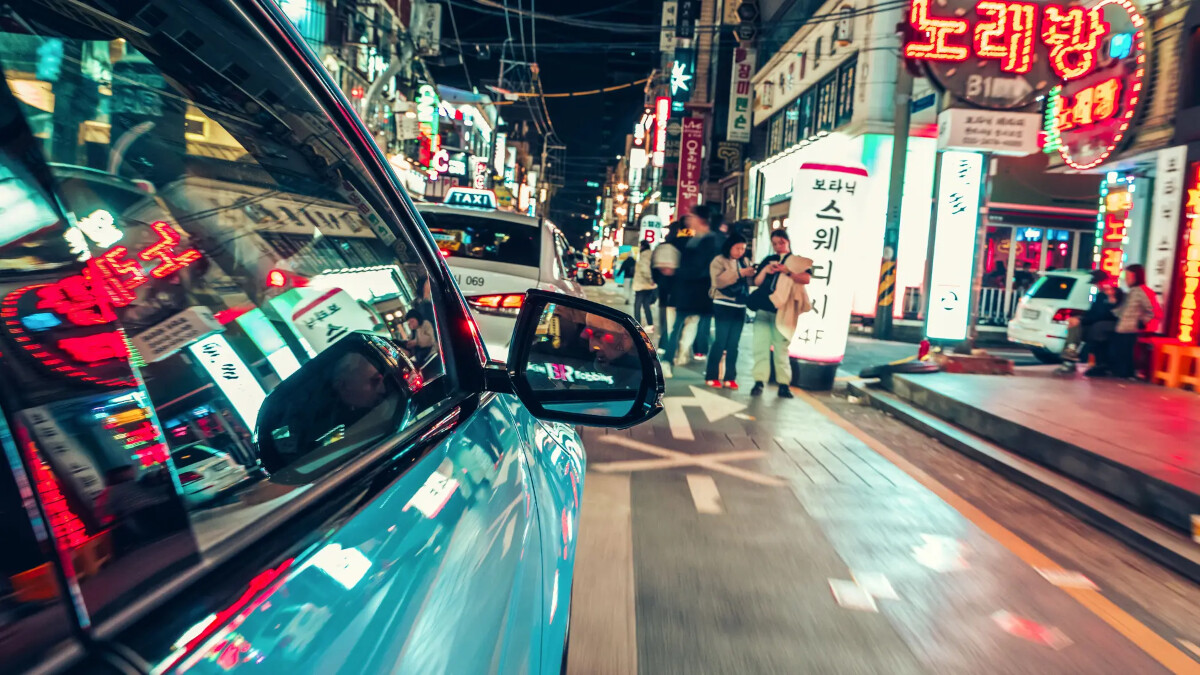
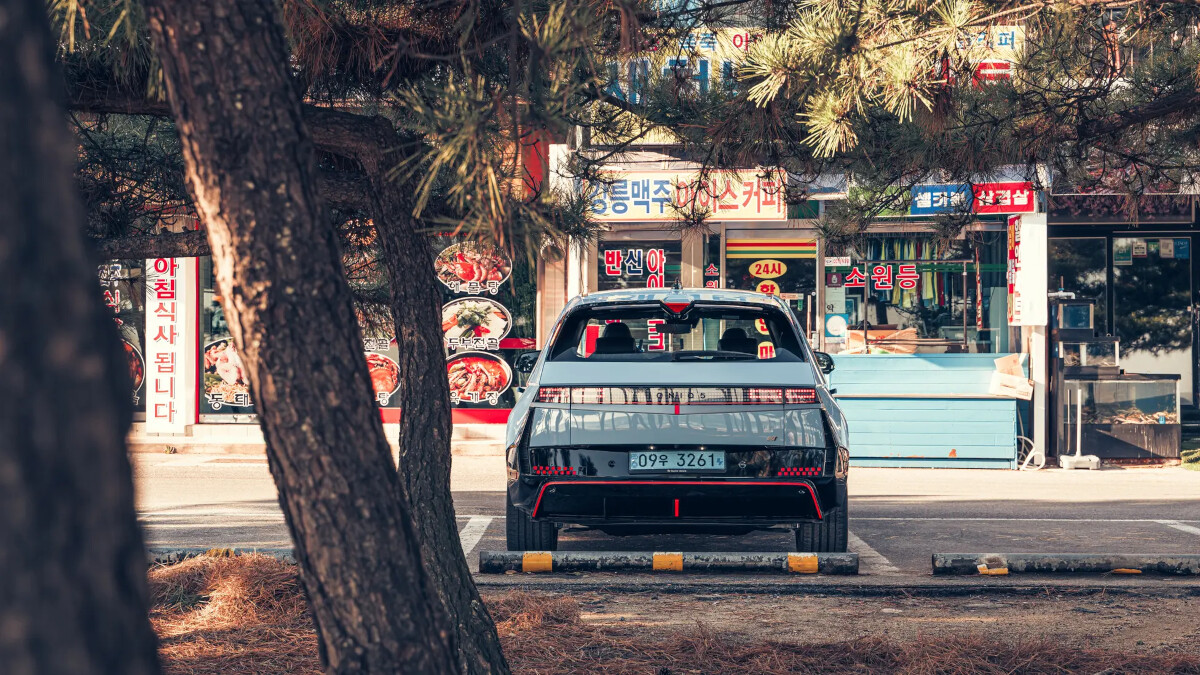
Seoul is a thoroughly modern megacity. Forests of apartment blocks stretching for miles, suburbs and center alike riven by eight-lane highways, and bridges crisscrossing the archipelago. In between, downtown is all narrow alleyways thronged with people walking from noodle bar to coffee shop. The traffic, when not jammed solid, is pretty caffeinated. It’s Milanese levels of nip and tuck.
So an EV, even this super-fast one, is just the thing. It’s responsive, urgent when it needs to be, and doesn’t take any learning. Just leave it in the default settings and it slots happily into the fray. It’s calm and undemanding, letting this neophyte concentrate on getting his bearings and remaining unscathed.
We’re somewhere near Gangnam late at night. The LG Twins’ baseball stadium has just disgorged a winning home crowd. It’s lively, as is the Korean way, but feels safe. Gaggles of young women in full team regalia don’t seem to be getting any hassle. It’s live and let live (unless you happen to be gay, sadly). When we block the road for a photo of our flashy blue car, the pedestrians don’t bother us. But if a cab driver can’t get by, they’ll hit the horn. There isn’t the rigid (if charming) deferential manner you get in Japan, South Korea’s near neighbor across a narrow strait of water.
Actually, the Koreans and Japanese aren’t great friends and you see almost no Japanese cars here. Some Mercedes-Benzes and BMWs, a few Minis and Land Rovers, but otherwise, it’s all local. Hyundai, Kia, and Genesis, Hyundai Motor Company’s three brands, account for an extraordinarily dominant 75% of all car sales here, having put the squeeze on Korean rivals SsangYong, Renault (formerly Renault-Samsung), and Chevrolet-Daewoo.
South Korea’s carscape reflects its national character. This is a country in and of itself. It’s highly connected, but doesn’t sponge up American, European, or other Asian influences. There are few McDonalds, but all my own continent seems to be contributing to Korea is designer handbags. I’m wary of the sort of travel writing you see in airline magazines that frames a description of the local culture in the outlook and prejudices of the writer’s own culture. But it often strikes me, during a week here, that while Koreans have their gaze firmly on the future—architecture, design, infrastructure, technology—they do it their way, and with respect for their heritage. But I didn’t come here to get stuck in traffic. Time to head out.
Korea is almost all mountains. It held the Winter Olympics in 2018, but most of its terrain isn’t the dizzying heights that get mountaineers excited or even break above the tree line. The skyline recedes into endless overlapping jagged topography that’s extremely beautiful but inimical to human settlement. In Seoul, the humans have defiantly beaten nature—even the airport is built on land reclaimed from the sea. Out in the country, nature wins, despite ambitious road-building programs. Highway 60 connects the coasts, Seoul in the east to Yangyang in the west. More than half of its 80km length is tunnel, another quarter viaduct. To stop you from dozing off in the tunnels, periodic LED rainbows shine from the roof, while occasional sections of changing frequency grooves are cut across the road, exciting a little tune from your tires.
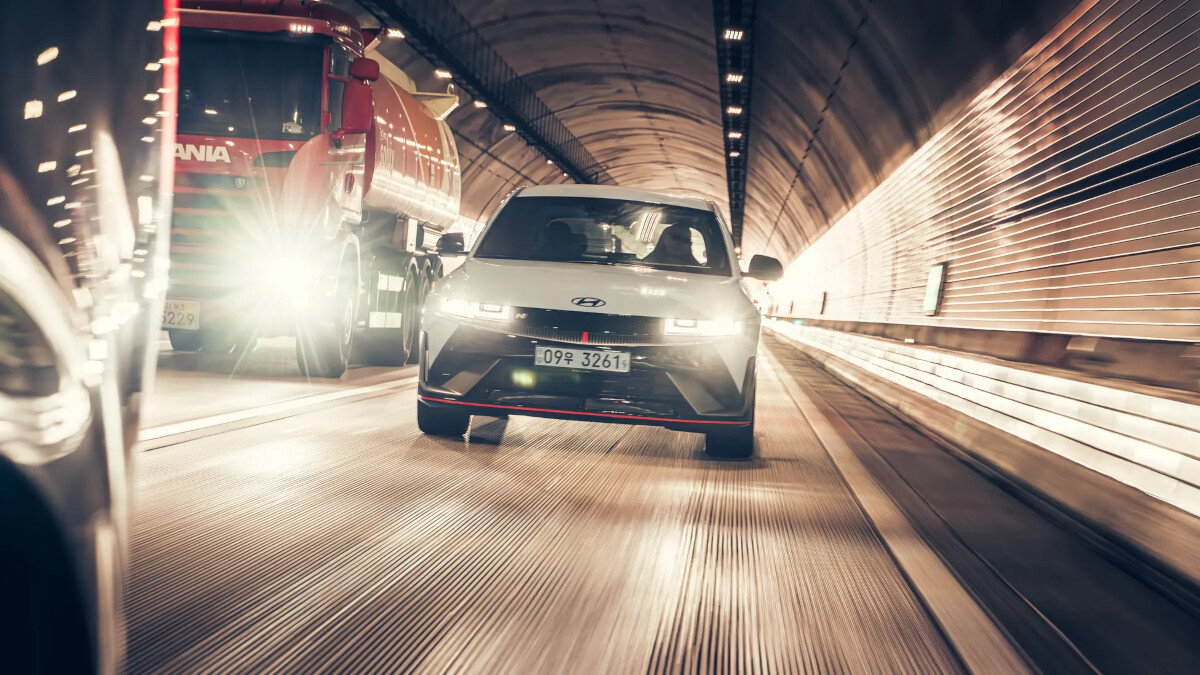
Anyway, the 5 N is still making everything simple here. It’s stable and has intuitive steering progression for pouring through long sweeping curves. With 609hp, you’re not going to have any trouble slotting into a busy outside lane, duh. There’s little noise, so I’m pounding the fine stereo. The heads-up display is superb, with clear guidance, of course, but also comprehensive speed camera warnings from an online database. During sections with average speed measurements, it even shows your own real-time average since the start camera and tells you how long until the end of the section. Anyhow, the cameras are prominently signed, so it seems the authorities can’t be bothered giving out tickets. After passing every 100kph camera, a high proportion of Korean drivers resume an 130-odd cruise.
You can pass through the electronic toll gates at about 60kph, with some on-board gadget communicating the transaction, and as you do, the car’s screen flashes up both the price and the amount left in your account. At least when operating in its own country, this is an amazingly well-connected car. Off the highway, the HUD even shows a little sign before every speed bump.
It all works so well, I’m inclined to trust the hands-on highway driver assist. It has intuitive wheel-spoke switchgear and is uncommonly smooth in tracing its lane and speed. The HUD shows graphics of the lane markings and the traffic around you, and it’s nearly always right. As is the blind-spot system.
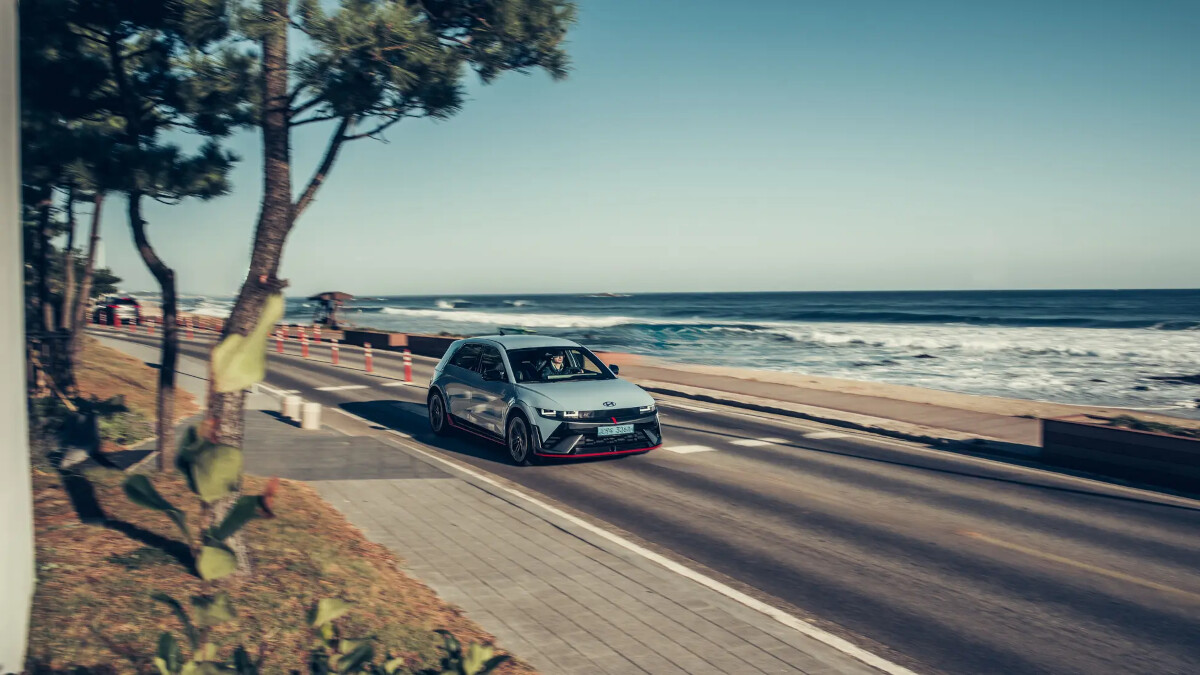
Gangwon province is a big, empty rugged area with implacable boundaries on two edges: the Sea of Japan (which, unsurprisingly, they call the East Sea) and the North Korean border. To encourage tourism, they’ve strung together a series of gorgeous routes collectively known as the Gangwon Nature Road. It’s 1,230km, and we’ve found the best bits, on a quiet dry autumn weekday.
From a distance, this car resembles a hot hatch. Close up, it looks like what it is—a largish, crossover-height 2.2-tonner togged up in sportswear. But from where I’m sitting, it’s a four-wheel-drive quasi-supercar, and a seriously good one at that.
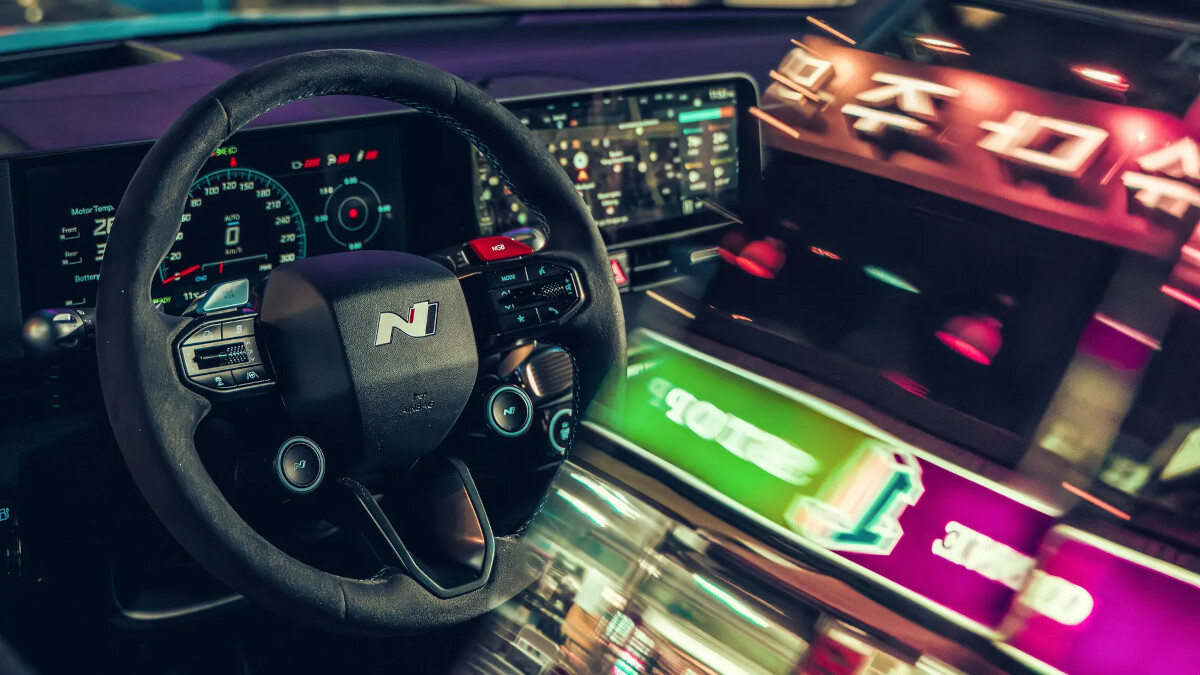
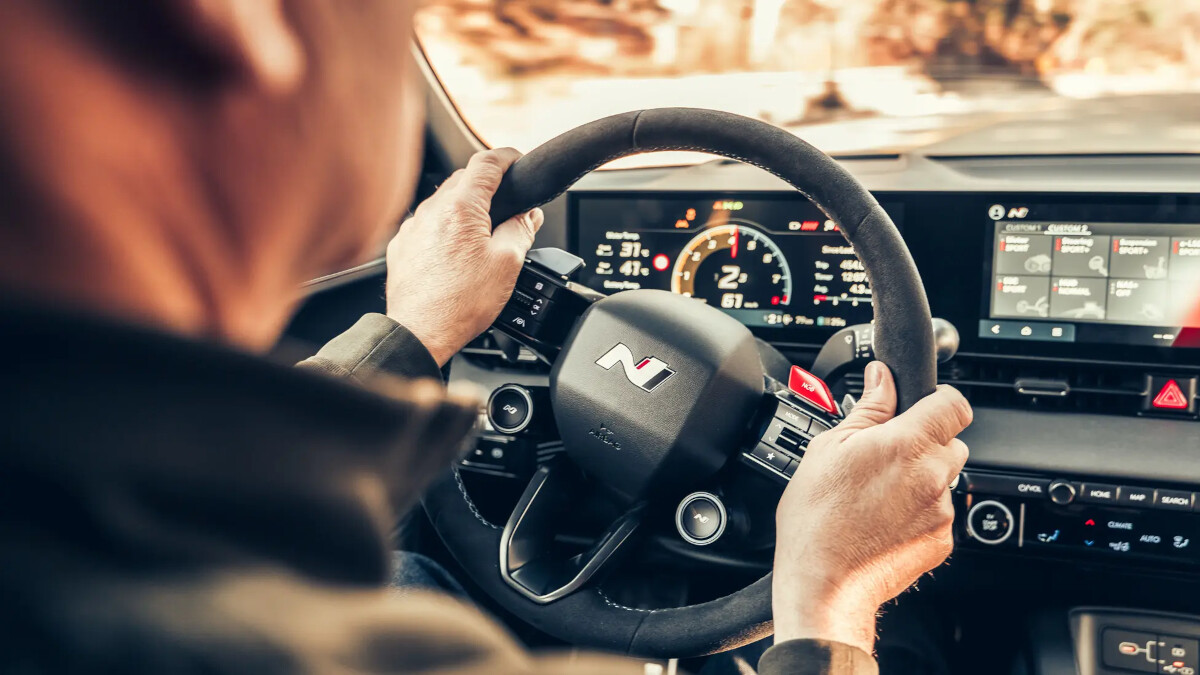
To make it that way, press the two N buttons on the steering wheel. I’ve got one configured for N custom mode, and the other for something called N e-shift. My N custom mode has sport accelerator, heaviest steering, sport torque distribution, and ESC in its middle setting. So far, so orthodox—it could be a Golf R.
N e-shift is anything but. It simulates a paddle-shift gearbox. You even get a rev counter. Blip the throttle when stopped in neutral and the ‘revs’ rise (they don’t—the motors are still).
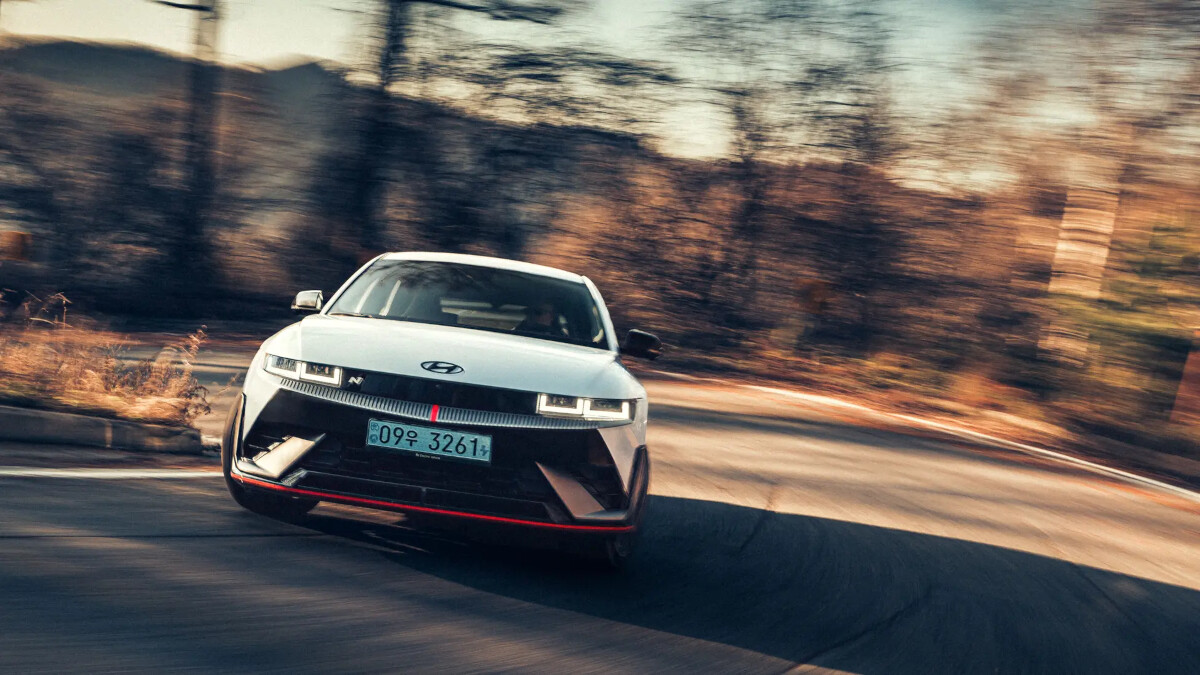
Head off in first and acceleration is ballistic, but when the tacho hits the red, you hit a wall of ‘rev limiter.’ Shift to second: Acceleration drops slightly but you can go faster. So on up through the ‘gears.’ You use them just like you normally would: Go to the redline in each for maximum acceleration—and it’s epic, given you have 609hp, or 650hp if you hit the 10-second boost button. Or short-shift if the road looks a bit slippery. Shift down on the way into a corner for extra engine braking. The 5 N has an extra inverter compared with the regular Ioniq 5, so it can pull 0.6g on regeneration alone, which is also excellent for going down the hills. The whole effect is brilliantly realistic and involving, even if it isn’t strictly the fastest way of getting about because just after the gearshifts it limits your torque until the ‘revs’ climb again.
And that’s only the half of it. N Active Sound simulates an engine noise (or you can select a jet engine sound, if you must). Sound generators are usually rubbish, out-of-phase gimmicks that you switch off after a mile. This is brilliant, utterly in sync with your foot position and ‘gear.’ The ‘engine’ goes the gamut from a deep, determined Stormzy through a moderately angry Sam Fender to a full screaming Jon Bon Jovi, changing tone with ‘throttle’ position and pitch with ‘revs,’ using all the speakers to simulate induction noise in front and exhaust behind.
Compared with any other EV, these sound and shifting effects give you critical extra dimensions in control of, and perception of, your speed and acceleration. It isn’t only super-involving, it helps you drive better. All without the nonsense of turbo lag, or indeed of annoying the people you pass with explosive exhaust noise outside the car (it does actually project a small amount of sound to the front and back, giving it a captivating 3D-effect from inside).

Once you hit the mountain passes, this Ioniq seems to shed about 400kg. It sniffs into a tight bend as keenly as a sports car should, using an e-diff, plus front-rear vectoring of torque and regeneration, to remarkable advantage. Traction is stout as you like, yet it’ll depart the apex with a nifty little loosening of the tail. In quicker bends, it’s properly locked on.
The 5 N has its own wide track and stiffened body shell, stronger subframes, all-new suspension arms and steering rack, big brakes, the whole nine yards. And don’t you know it. This isn’t a game: The road isn’t just some digital ray-traced rendering through the windshield. The newly engineered precision means you feel it, sensing the tires doing their thing, the dampers riding dips and crests, checking the body motions so you’re not perturbed. Everything’s on high alert, nothing’s out of control. And up at the col, there’s a little cafe. We stop, take a deep breath, and have a coffee gazing across the vista. Then jump back in and do it again.
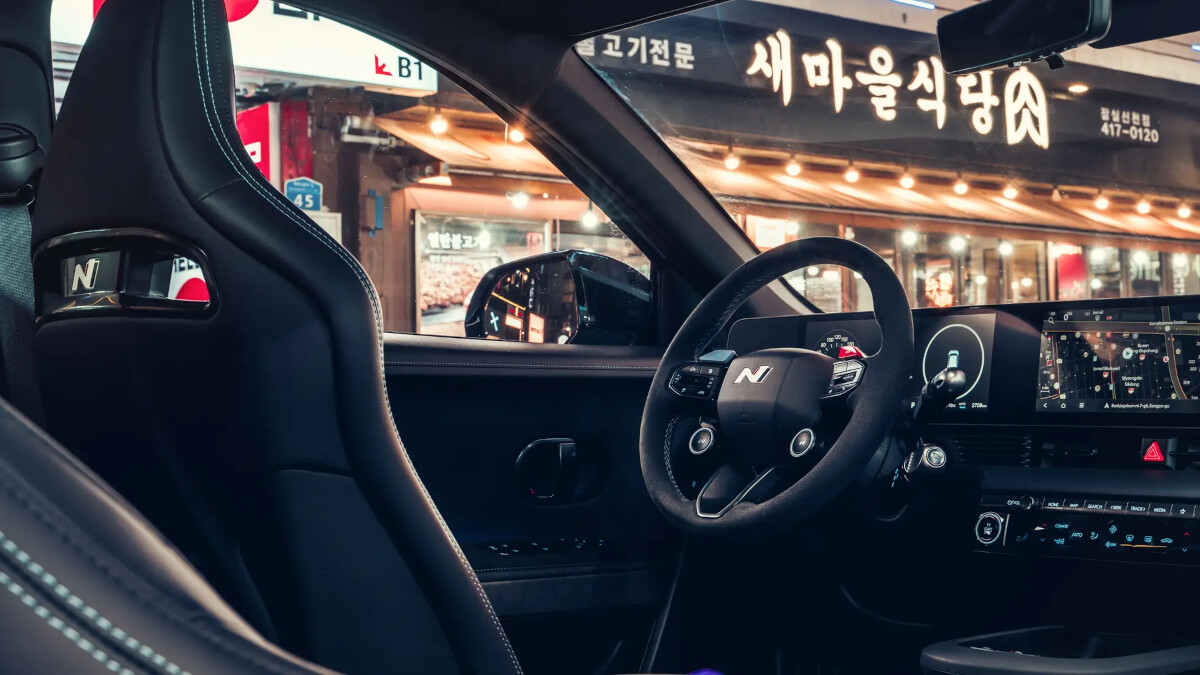
It’s out of season along the Gangneung shoreline. Beaches are fringed with big hotels, little cafes, amusement parks, and piers, all but deserted. We mooch along in the cool clear autumn sun. The N model doesn’t have the pillowy softness of the regular Ioniq 5, but its comfort mode still does what it says. The look and feel of the cabin are different, though, all black trim with sport-signaling stitch patterns, suede-alike fabric, and special screen graphics. You sit in excellently bolstered front seats. Hyundai is an admirable holdout against the march of the touchscreen, so you’ve got dedicated buttons for climate and a whole lot else. Fine stereo, too. The rear, as in the base car, is super accommodating thanks to sliding reclining seats with big legroom, plus loads of lights, vents, USB ports, and storage. You could use this car for exec minicabbing. It’s like a backwards mullet: business out back, party in front.
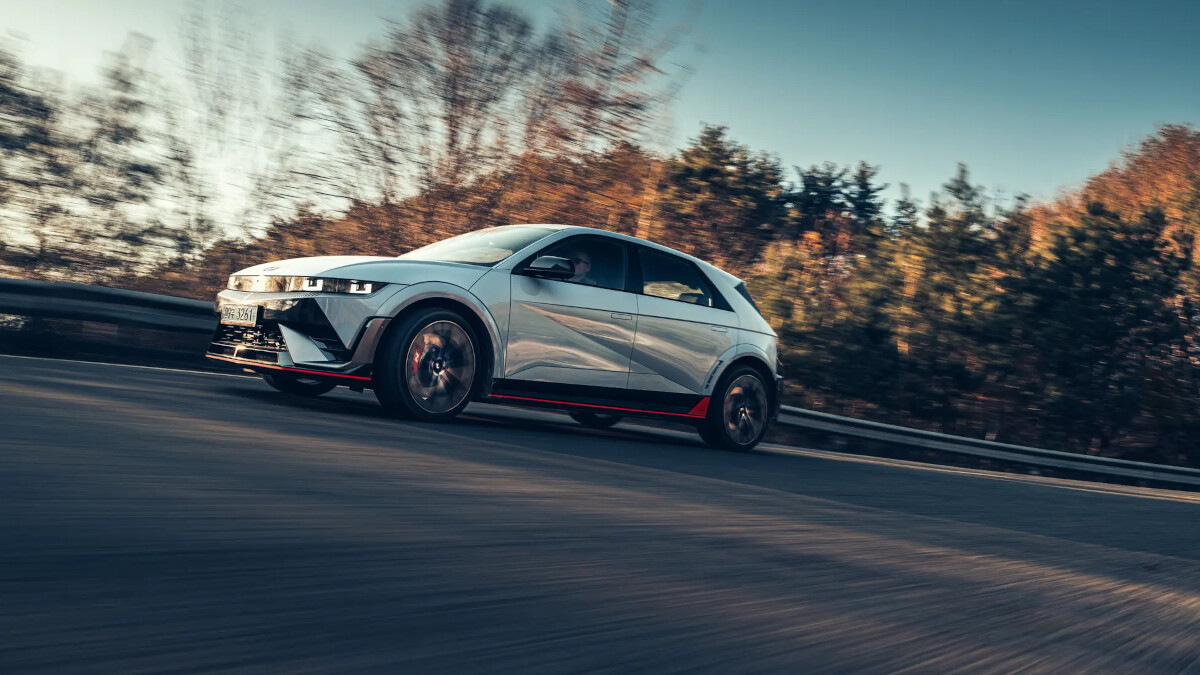
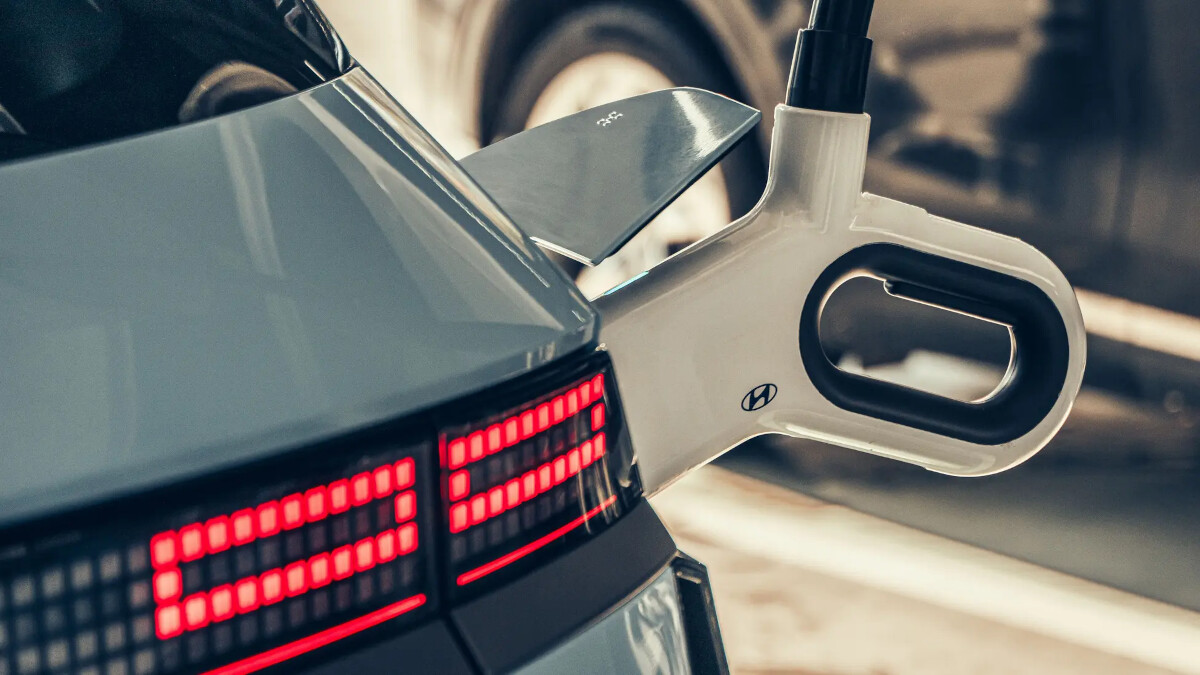
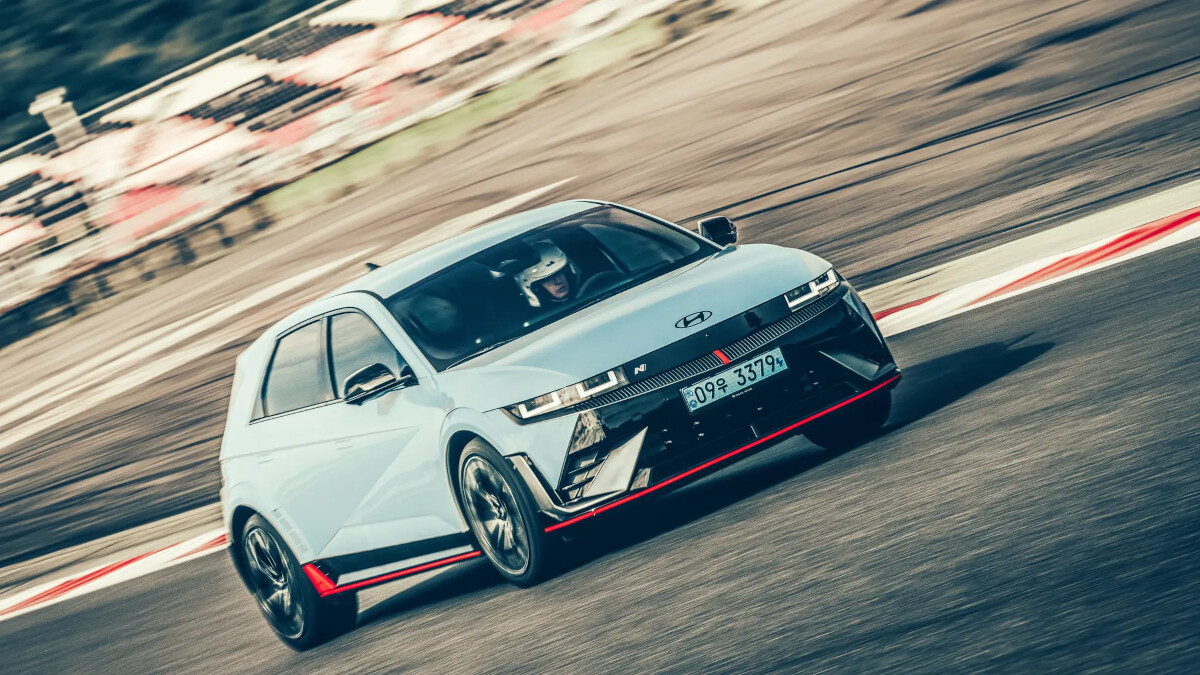
Back inland now, because Korea’s GP-standard track is waiting, 560km to the southwest. With our mix of driving, by no means all of it at full vigor, real-world range is 320-350km. That’s no limitation as it makes the best of super rapid chargers. The thing sucks power at well above 220kW, and it’s already ready to go before I’ve been to the toilet and downed my mildly spiced dumplings and sweet sesame paste buns. An N car has to be track-capable, goes the claim. As the engineers and marketers are mostly Korean and German, they mean the Nürburgring Nordschleife, where they do a lot of honing. And hooning. The Hyundai group’s e-GMP platform and its 800V electrics are vital, they say. High voltage reduces current and with it heat generation. It means you can do a 20-minute track session without overheating the battery or motors, and then get enough charge in the next 20 minutes to do it again. That’s why Hyundai N is installing banks of rapid chargers in tracks around the world. Highway services for Tesla’s Superchargers, pit lanes for this lot.
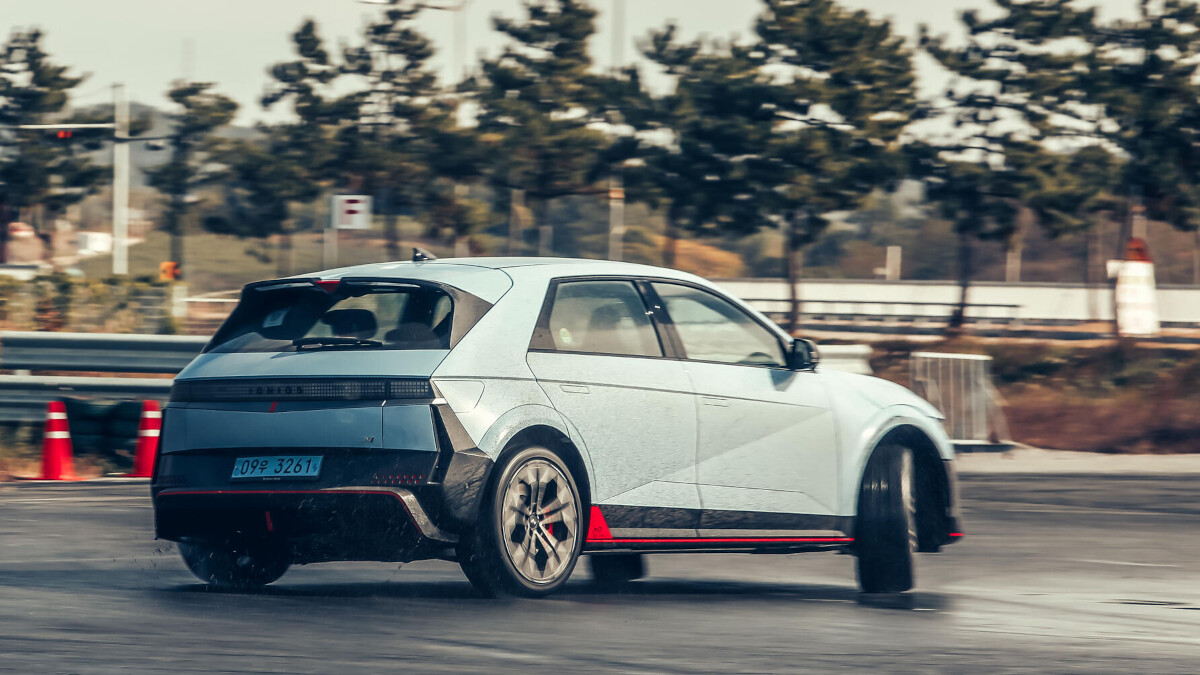
The dash screen has a whole bank of extra N settings for track driving. Well, of course. For drag-strip runs, you can choose battery preconditioning, a boost to 650hp, and launch control. Set battery management into sprint mode for absolute full power, or endurance mode to trim the peaks for longer sessions. For drifting in the wet, a special mode chucks the tail out with the back motor, then brings in the ESP and front motor to hold the angle. Well, so they say. Here I am in an empty, wet car park and it still has frankly too much power and a load of rotational inertia, so once a spin begins, it’s already beyond me to stop it. And they admit drifting in the dry is an extreme shortcut to rooted tires.
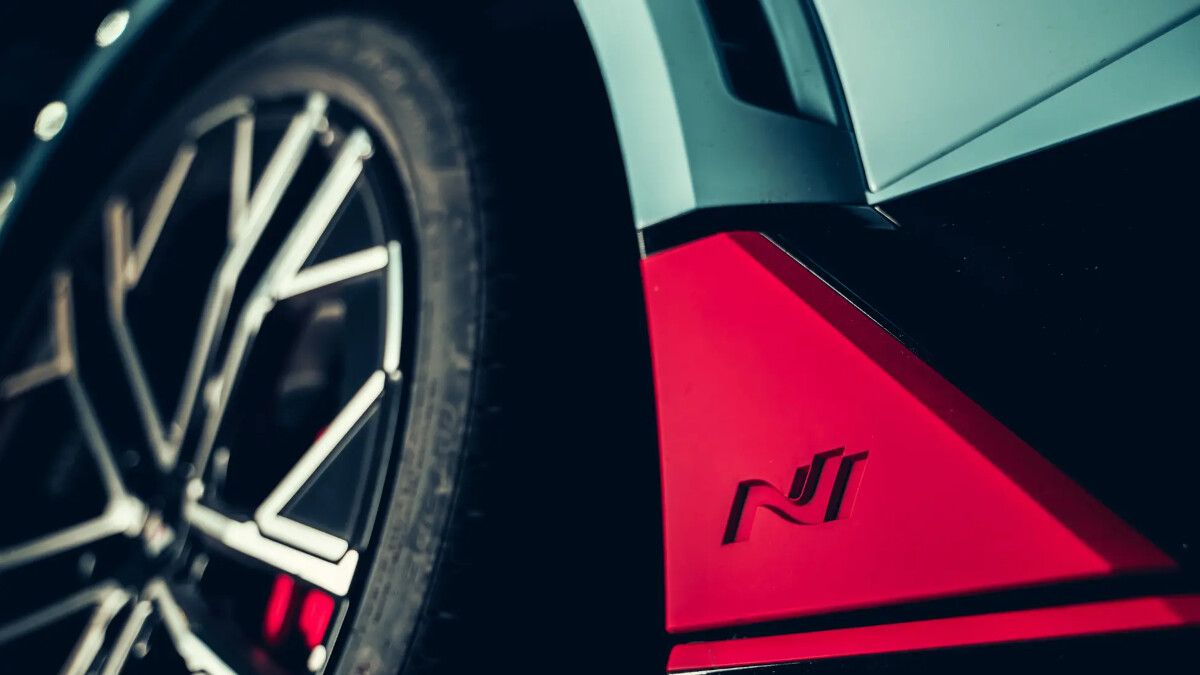
Of more actual use on the track is N pedal, which sets up extreme and vectored regen braking to swing it even more sharply toward the apex. With that engaged, you can do a swift-ish lap without touching the brake pedal at all. And if you do use the friction, too, that’s the way to its fastest lap (7min 50sec, you ’Ring obsessives). But it’s incompatible with N-shift, so pick your pleasure. Yeah, there’s scope for a slightly firmer physical brake pedal and you sense a little squirm from the tires—given the weight and the power, they’re being given an unconscionable amount to do. But all in, the 5 N, when sent out onto a track to do what you’d never expect of a big EV, overdelivers to a staggering extent. With the dampers in the most tense setting, they control the body and put an iron resolution into the cornering. The limit is friendly, and the wheel and the accelerator give you options to trim the line.
Nah, it isn’t supercar fast round a track, but it’s colossal fun. Forget any ‘for an EV’ qualifiers—it’s huge fun, full stop. It turns a page for electric cars, which means a new page for cars.
More photos of the Hyundai Ioniq 5 N in South Korea:
NOTE: This article first appeared on TopGear.com. Minor edits have been made.