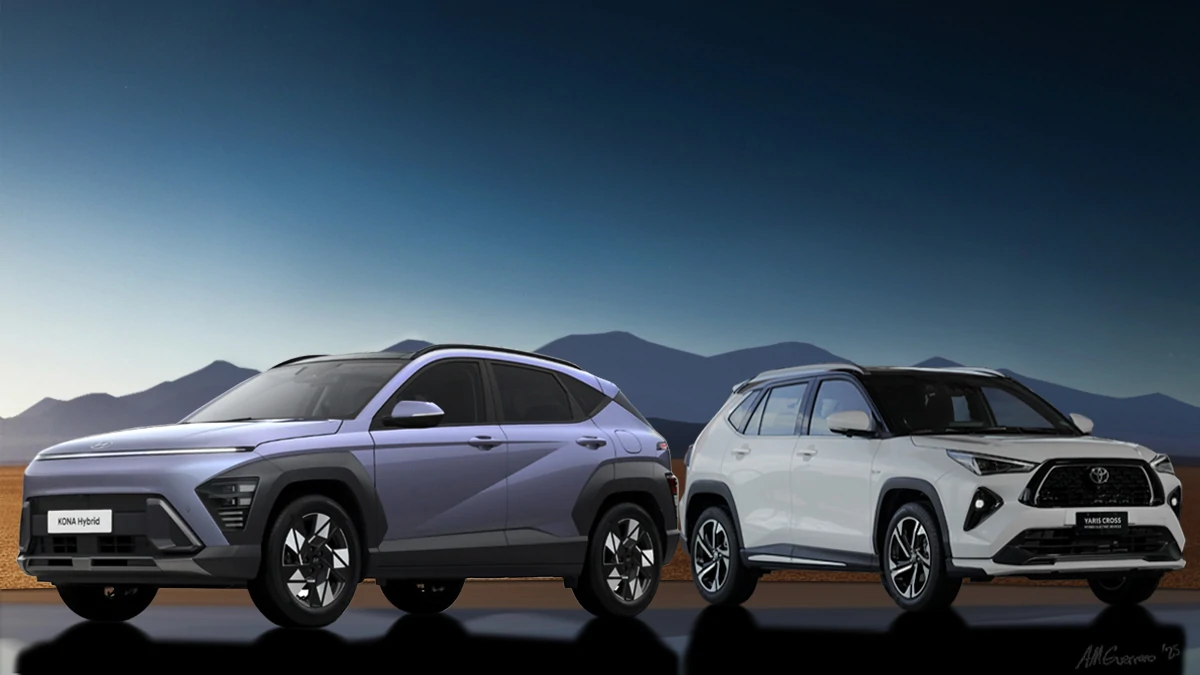


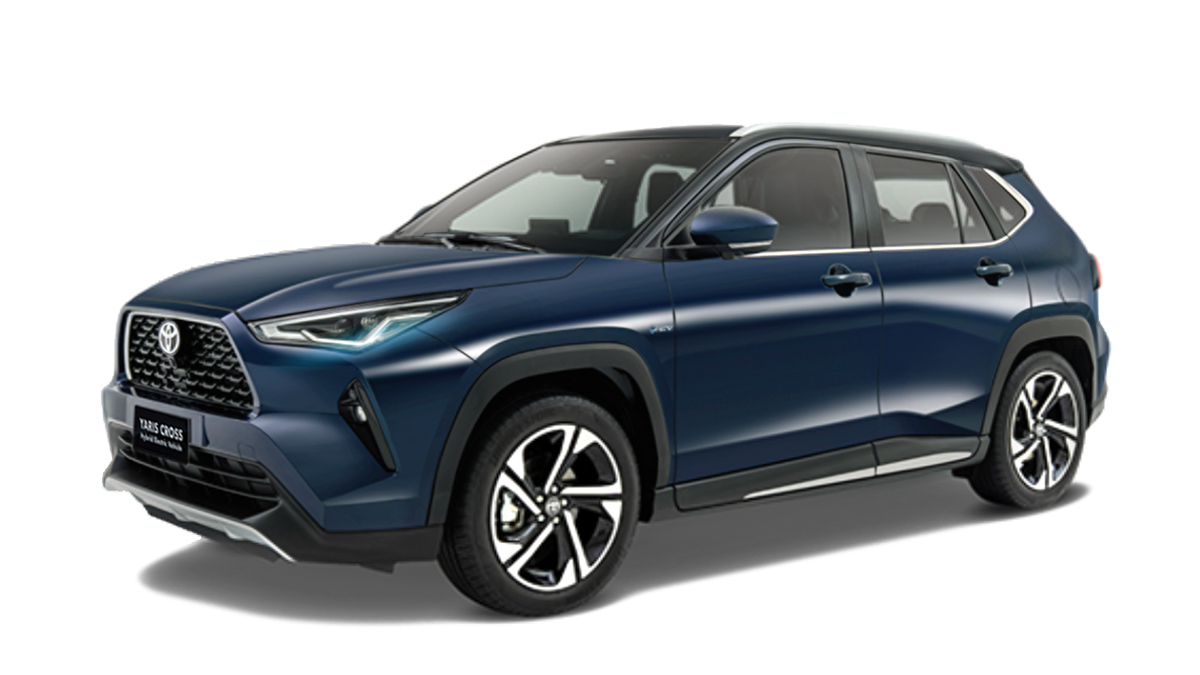
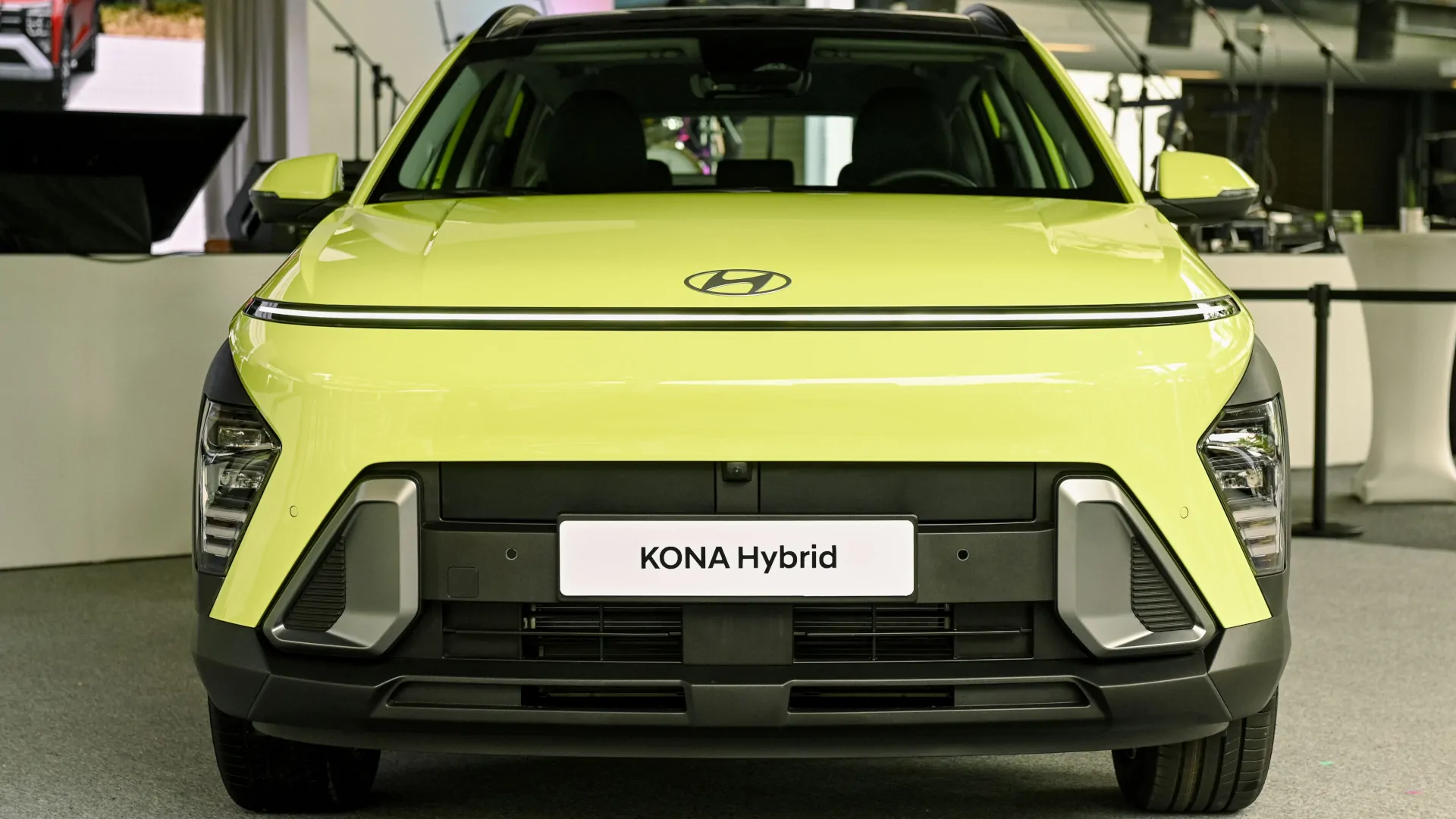
Hyundai recently launched its second-generation Kona in the country. The updated version of the Korean carmaker’s quirky, futuristic subcompact SUV is now hybrid-only in the Philippines. For this spec-sheet brawl, we’ll be pitting the range-topping Hyundai Kona 1.6 HEV Premium against the new top-of-the-line variant of the Toyota Yaris Cross, the 1.5 SE HEV. Let the battle of the subcompact hybrids begin!
Both featured vehicles are self-charging hybrids, so no need to plug-in. The Hyundai Kona HEV is powered by a 104hp, 1.6-liter gasoline engine paired with a 43hp electric motor; its total system output is 139hp. The Yaris Cross HEV is propelled by a 90hp, 1.5-liter gasoline unit mated to a 79hp electric motor; its total system output is 109hp. Note that the electric motor output is taken from the spec-sheet of a similar overseas model. As expected, these hybrids have small fuel tanks, 38 liters for the Hyundai, and 36 liters for the Toyota. As for their transmissions, the Kona HEV uses a dual-clutch transmission while the Yaris Cross HEV uses a CVT.
The Kona HEV and Yaris Cross HEV are both front-wheel drive SUVs. The Hyundai comes with an independent multi-link rear suspension, a feature that is not very common in the subcompact segment. The Toyota, on the other hand, features a conventional torsion beam setup at the rear.
OTHER STORIES YOU MIGHT HAVE MISSED:
How to protect yourself from leptospirosis this rainy season
‘You can fundamentally change a car with software,’ says Hyundai’s tech boss
Both vehicles have a long list of safety features that include six airbags, ABS, electronic stability control, and advanced driver assistance systems. On the infotainment side of things, the Kona HEV Premium comes with a 12.3-inch touchscreen, while the Yaris Cross SE HEV comes with a 10.1-inch touchscreen. Like most vehicles nowadays, both come standard with Apple CarPlay and Android Auto. The Hyundai has a power tilt and slide moonroof, while the Toyota has a larger but fixed panoramic moonroof. Both have power liftgates, but the Yaris Cross SE HEV has a kick sensor. The range-topping Hyundai also has an auto-dimming rearview mirror, while its Toyota rival has a digital rearview mirror.
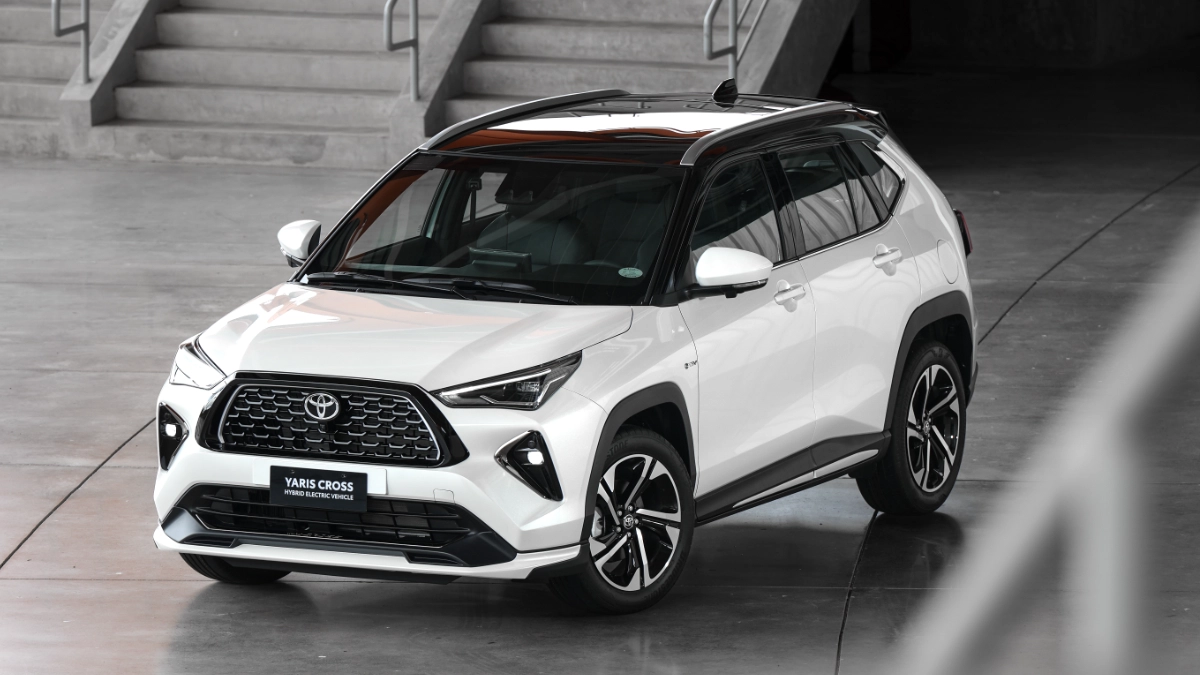
How big are they? At 4,350mm x 1,825mm x 1,585mm, the Kona is 40mm longer, 55mm wider, and 30mm lower than the Yaris Cross. At 170mm, the Hyundai’s ground clearance is 42mm less than the Yaris Cross.
It’s a close fight between the P1.688 million Kona 1.6 HEV Premium and the P1.69 million Yaris Cross 1.5 SE HEV. If you’re still not quite sure which of these two subcompact hybrid SUVs you’d go for, check out the side by side specs we prepared and let us know which one is the winner for you.
Hyundai Kona 1.6 HEV Premium |
Toyota Yaris Cross 1.5 SE HEV |
|
| Price (Philippine Peso) | 1,688,000 | 1,690,000 |
| Drive | FWD | FWD |
| Seating capacity | 5 | 5 |
| Engine Type | 1.6-liter inline-4 gasoline | 1.5-liter inline-4 gasoline |
| Power (hp) | 104 | 90 |
| Torque (Nm) | 144 | 121 |
| Electric motor power (hp) | 43 | 79 |
| Total system output (hp) | 139 | 109 |
| Fuel tank capacity (liters) | 38 | 36 |
| Transmission | 6-speed dual-clutch transmission | continuously variable transmission |
| Paddle shifters | yes | no |
| Brakes (front/rear) | disc/ disc | disc/ disc |
| Wheels | 18-inch alloy | 18-inch alloy |
| Tires | 215/55R18 | 215/55R18 |
| Front suspension | independent MacPherson strut | independent MacPherson strut |
| Rear suspension | independent multi-link | torsion beam |
| Seat material | synthetic leather | synthetic leather |
| Infotainment system | 12.3-inch touchscreen | 10.1-inch touchscreen |
| Connectivity | Apple Carplay + Android Auto | Apple Carplay + Android Auto |
| Wireless charger | yes | yes |
| Speakers | 6 | 6 |
| Rear A/C vents | yes | yes |
| Airbags | 6 | 6 |
| ABS w/ electronic brakeforce distribution | yes | yes |
| Electronic stability control | yes | yes |
| Cruise control | yes (adaptive) | yes (adaptive) |
| Hill-start assist | yes | yes |
| Collision mitigation system | yes | yes |
| Rear-cross traffic collision warning | yes | yes |
| Lane-keep assist | yes | yes |
| Blind-spot monitoring | yes | yes |
| Rearview mirror | auto-dimming | digital |
| Camera | 360-view | 360-view |
| Parking sensors | front + rear + side | front + rear |
| Headlights | LED | LED |
| Taillights | LED | LED |
| Roof rail | yes | yes |
| Moonroof | yes (power tilt & slide) | yes (fixed panoramic) |
| Power liftgate | yes | yes (w/ kick sensor) |
| Dimensions (mm) | 4,350 x 1,825 x 1,585 | 4,310 x 1,770 x 1,615 |
| Wheelbase (mm) | 2,660 | 2,620 |
| Ground clearance (mm) | 170 | 212 |